Engineering Consultancies
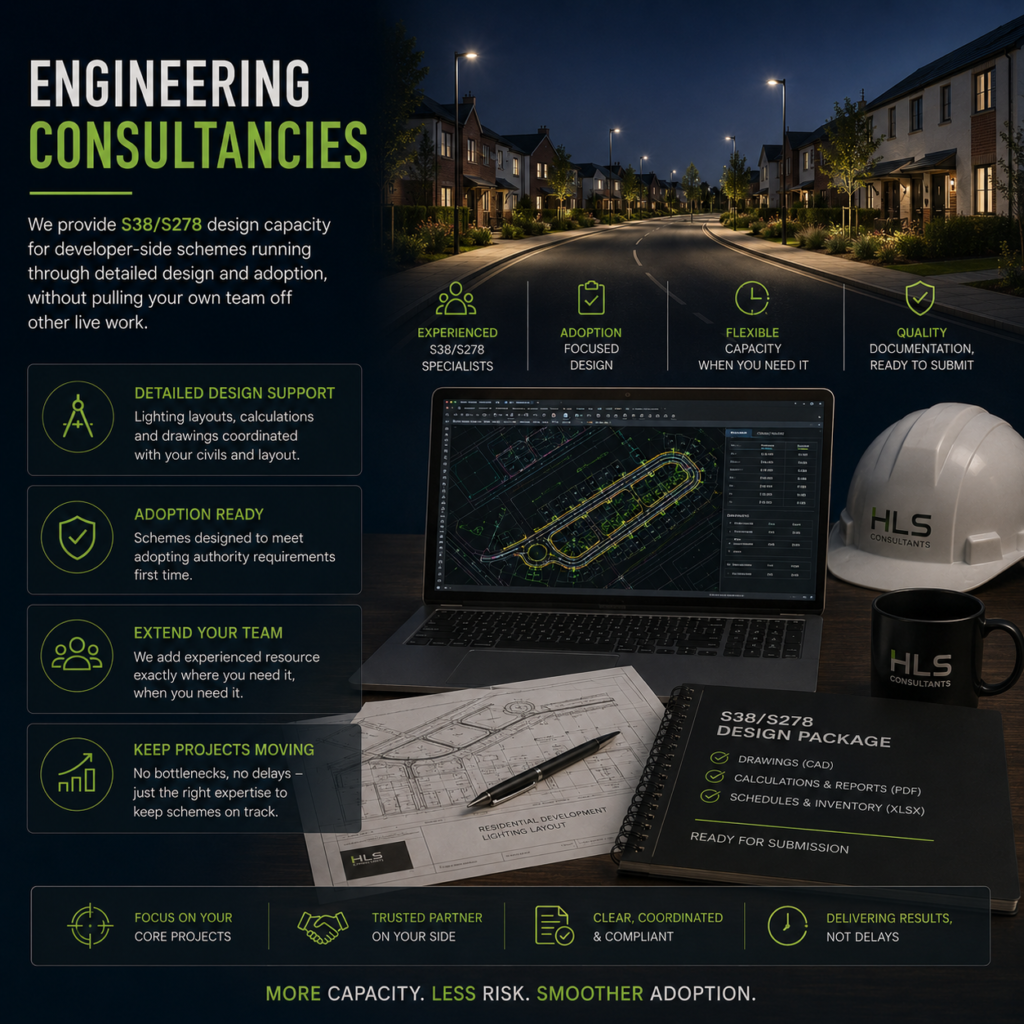
We provide S38/S278 design capacity for developer-side schemes running through detailed design and adoption, without pulling your own team off other live work.
Residential development lighting sits on the critical path to adoption. A Section 38 or Section 278 lighting package that's miscalculated, under-documented, or submitted in a format the authority doesn't recognise doesn't just risk its own rejection — it can hold up handover of the wider development.
HLS Consultants is a specialist residential development lighting design consultancy, providing calculation-led, standards-compliant lighting design for housing developments, Section 38 and 278 infrastructure, and community spaces across the United Kingdom, Ireland, and the Middle East.
Whether you're an engineering consultancy running a masterplan-led regeneration scheme, a Tier 1 contractor delivering lighting as part of a town centre redevelopment contract, a local authority relighting a park or plaza, or an infrastructure developer with shared amenity spaces to light within a wider development, our public realm lighting design service is built around one outcome: a scheme engineered to minimise the risk of rework at technical review, without losing the character it was designed to have.
HLS Consultants is a design-only lighting consultancy — we do not supply luminaires and we do not carry out installation, electrical connection works, or statutory approval submissions. What we deliver is the technical backbone of a compliant residential lighting scheme: the design, the calculations, the verification, and the documentation your team, contractor, or authority needs to move a scheme toward adoption.
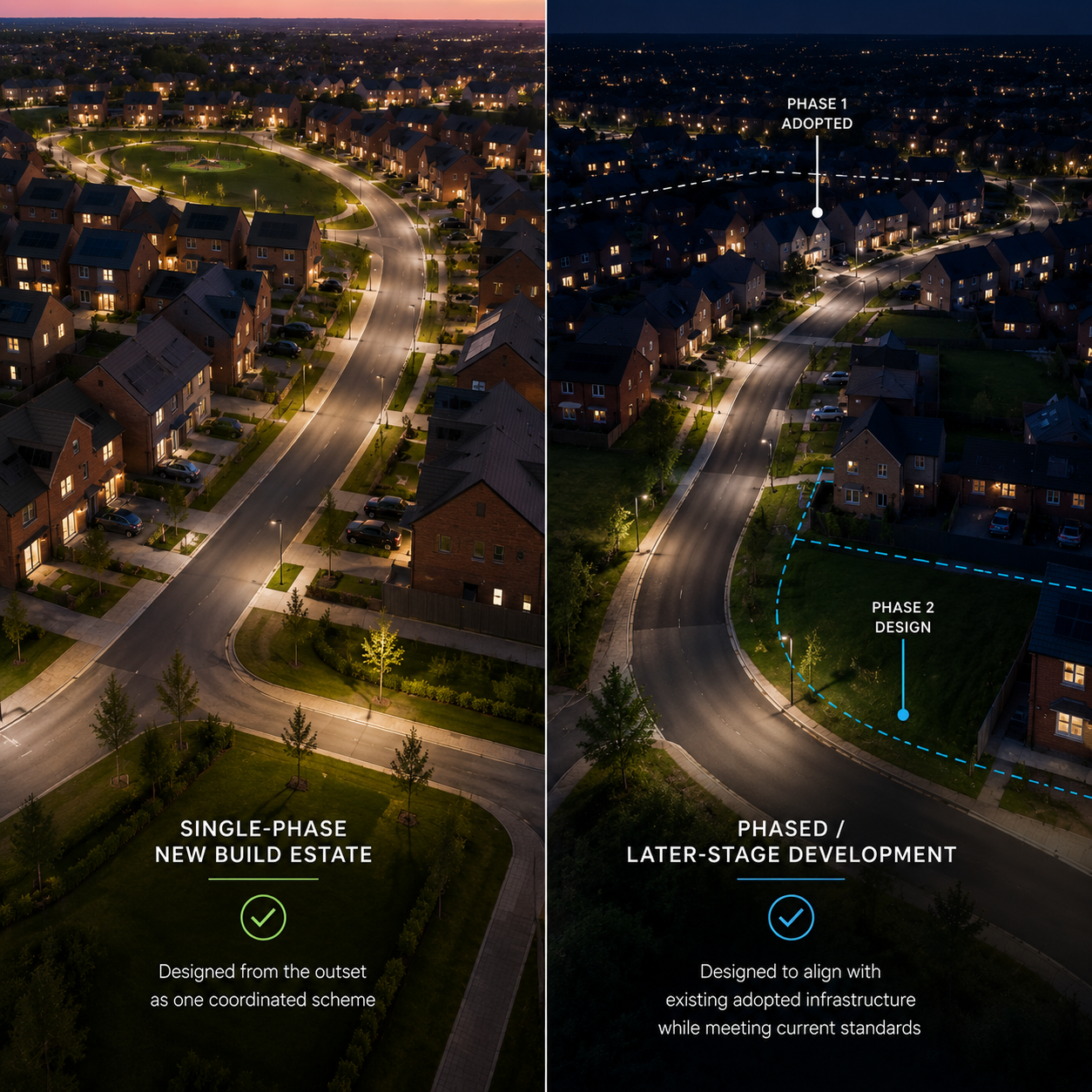
Our residential development lighting design service covers housing development roads and estate lighting, Section 38 (developer-led adoptable roads) and Section 278 (highway works agreements) schemes, and community spaces within residential developments — for new build developments and phased schemes alike, including lighting design for later phases of an already-adopted development. This makes the service equally relevant whether a scheme is a single-phase estate going through adoption for the first time, or a multi-phase development where lighting needs to be designed consistently across several submission rounds.
Section 38 and Section 278 lighting design is judged against a stricter bar than most other lighting disciplines, because the outcome isn't just a compliant scheme — it's a scheme the adopting authority is prepared to take permanent responsibility for maintaining. A design that's calculated to the wrong classification, documented inconsistently with the rest of the S38/S278 submission, or misaligned with the site's drainage and road geometry tends to surface as a query or rejection at exactly the stage a developer least wants delay: the point where adoption is meant to be finalised.
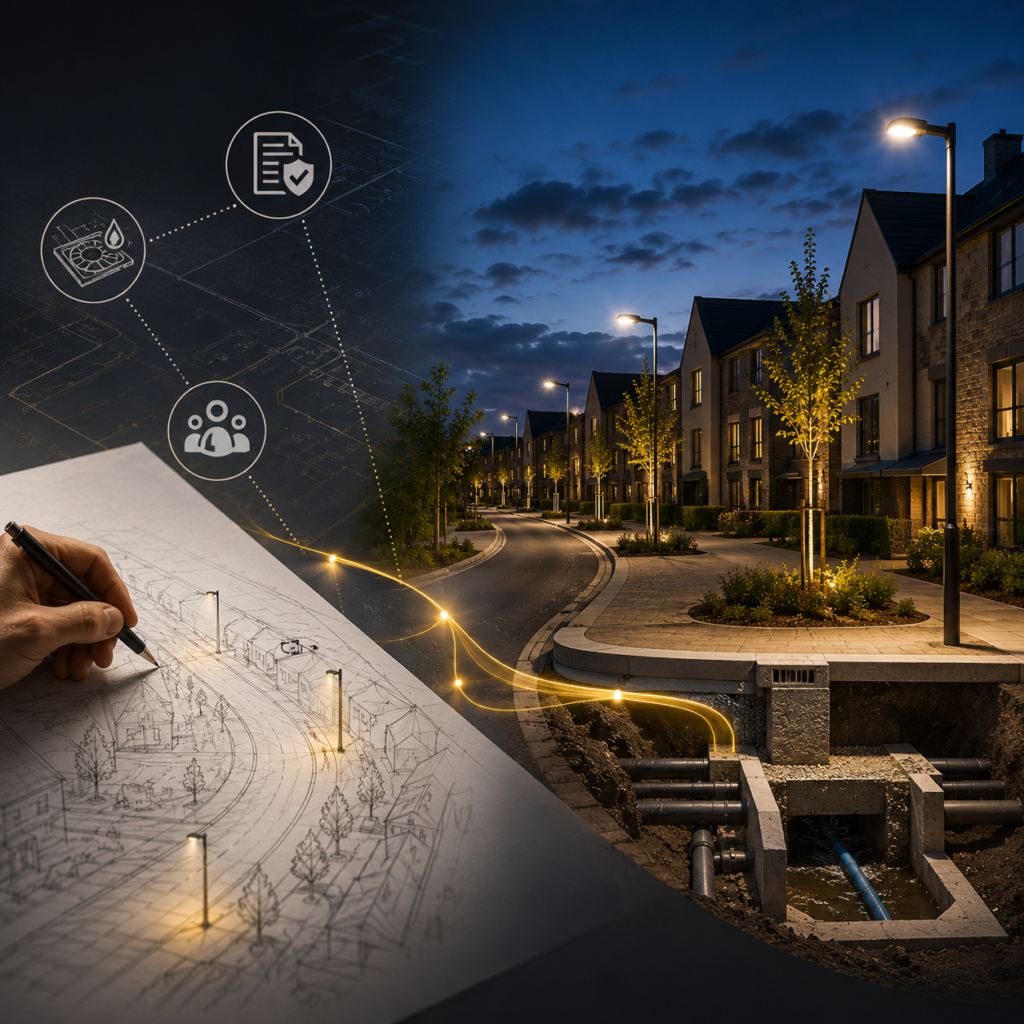
This is the risk a specialist residential development lighting design consultancy is built to reduce. HLS Consultants treats the adopting authority's expected standard as the starting brief, not a checklist applied at the end — calculating to BS EN 13201 and BS 5489-1 from the outset, and coordinating directly with the site's civil engineering design so the lighting package aligns with drainage, road geometry, and utility layouts before it's ever submitted.
Residential development lighting design generally falls into one of two categories. Single-phase new build schemes start from a clean design brief, where the lighting layout is designed alongside the estate's road geometry and drainage from the outset, as one coordinated S38 or S278 submission. Multi-phase developments are different: lighting for phase one may already be adopted, and later phases need to be designed consistently with what's already on the ground, while still meeting current classification standards, which may have changed since the earlier phase was approved.
HLS Consultants designs for both. On single-phase schemes, we build the lighting layout and calculations from first principles alongside the site's civil design. On phased developments, we design later phases to align with the existing adopted infrastructure wherever possible, flagging where a change in column position, spacing, or specification is genuinely required by current classification requirements — rather than either ignoring what's already adopted or defaulting to a full redesign that creates inconsistency across the development.
Section 38 and Section 278 lighting schemes tend to run into a similar handful of problems, regardless of region. A lighting layout is designed without full coordination with the civil engineering design, and clashes with drainage or utility runs surface only once both designs reach the adopting authority. A submission is documented in a format the specific authority doesn't recognise, creating a query cycle that has nothing to do with the underlying design quality. A later phase of a development is lit inconsistently with an already-adopted earlier phase, creating a mismatched estate and a harder adoption conversation for the developer.
Each of these is a coordination and process failure, not a technical one — and each is avoidable with a design process that aligns with the site's civils from the outset, documents to the specific authority's expected format, and treats a multi-phase development as one continuous design brief rather than a series of disconnected submissions. That's the process HLS Consultants applies to every residential development lighting scheme, regardless of scale or region.
Every residential development lighting scheme we design follows the same structured, verifiable process — from the survey data you provide through to a fully checked documentation package ready for adoption submission.
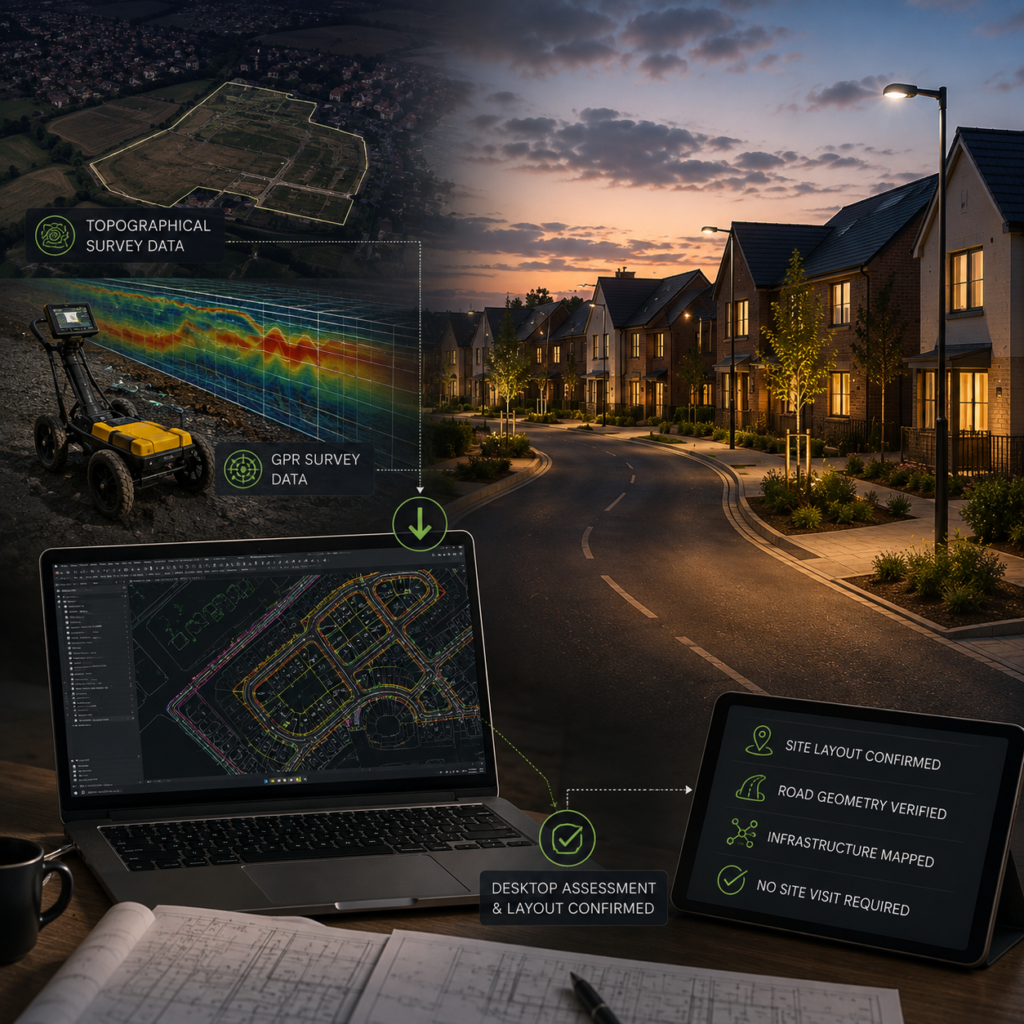
You supply topographical and GPR survey data for the development. We carry out desktop assessment using aerial and mapping data to confirm site layout, road geometry, and existing infrastructure — no site visit is required from HLS directly. This keeps the design process fast to start and easy to run alongside your civils team’s own workload.
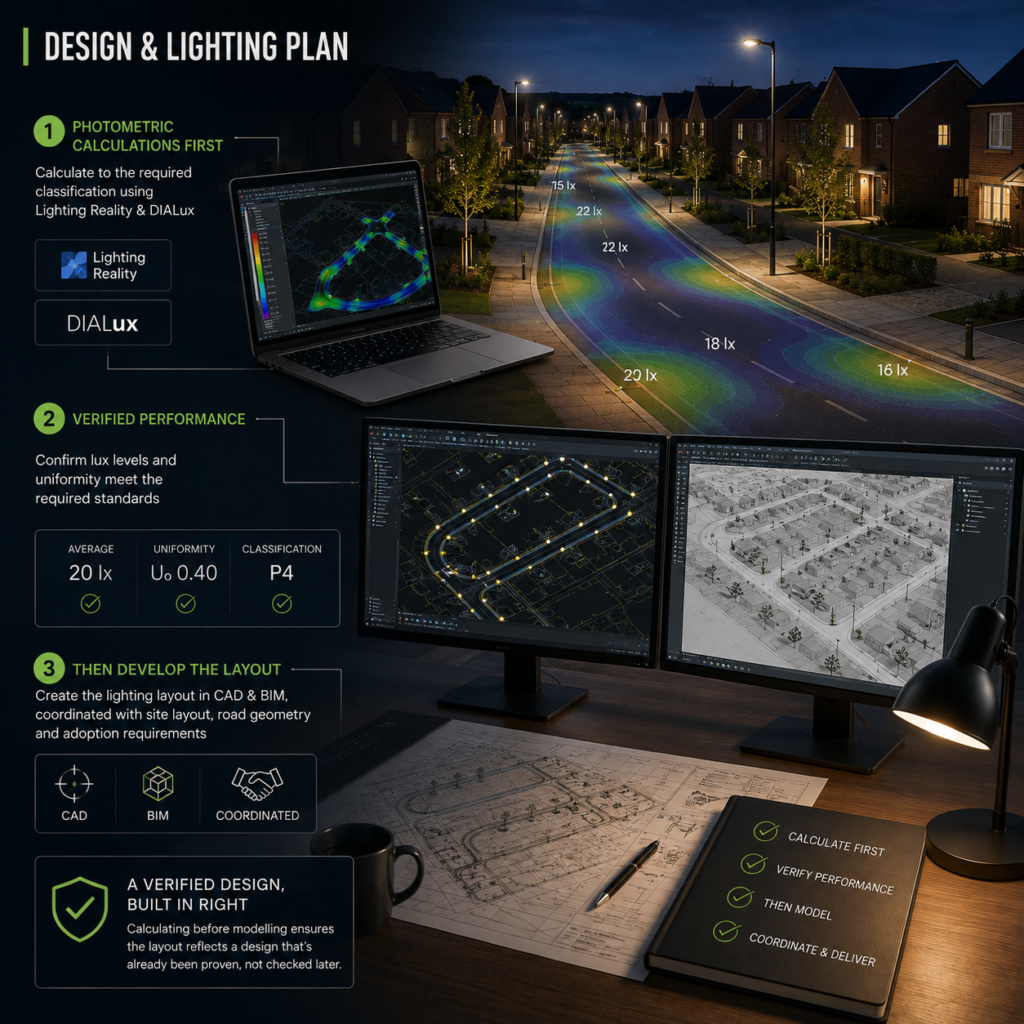
Photometric calculations are carried out first, using Lighting Reality and DIALux, to establish the lux levels and uniformity required for the scheme’s classification. Only once the calculation is correct do we develop the layout in CAD and BIM, coordinated with site layout, road geometry, and adoption requirements. Calculating before modelling means the layout reflects a design that’s already been verified, not one that’s checked after the drawing is complete.
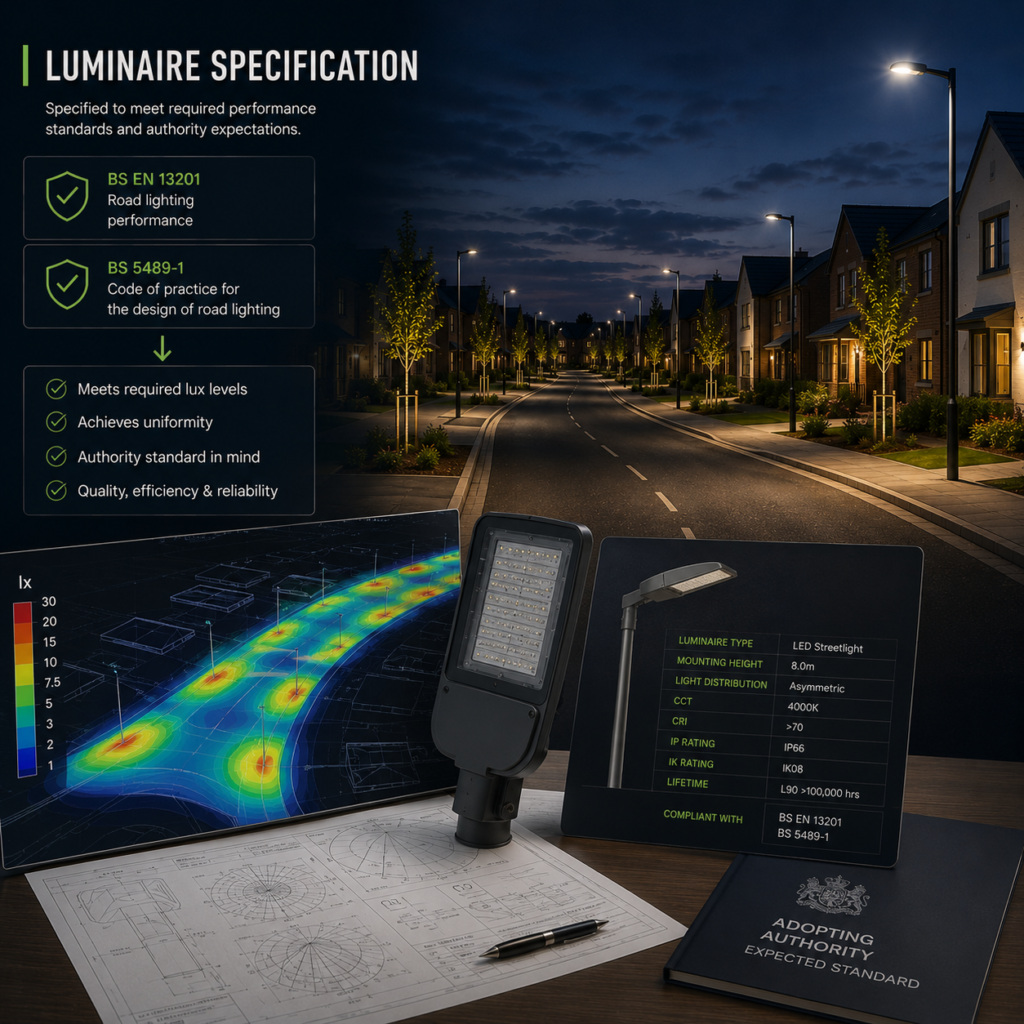
Fixture and luminaire specification is selected to meet the required lux levels and uniformity under BS EN 13201 and BS 5489-1, specified with the adopting authority’s expected standard in mind rather than a generic residential fixture palette.
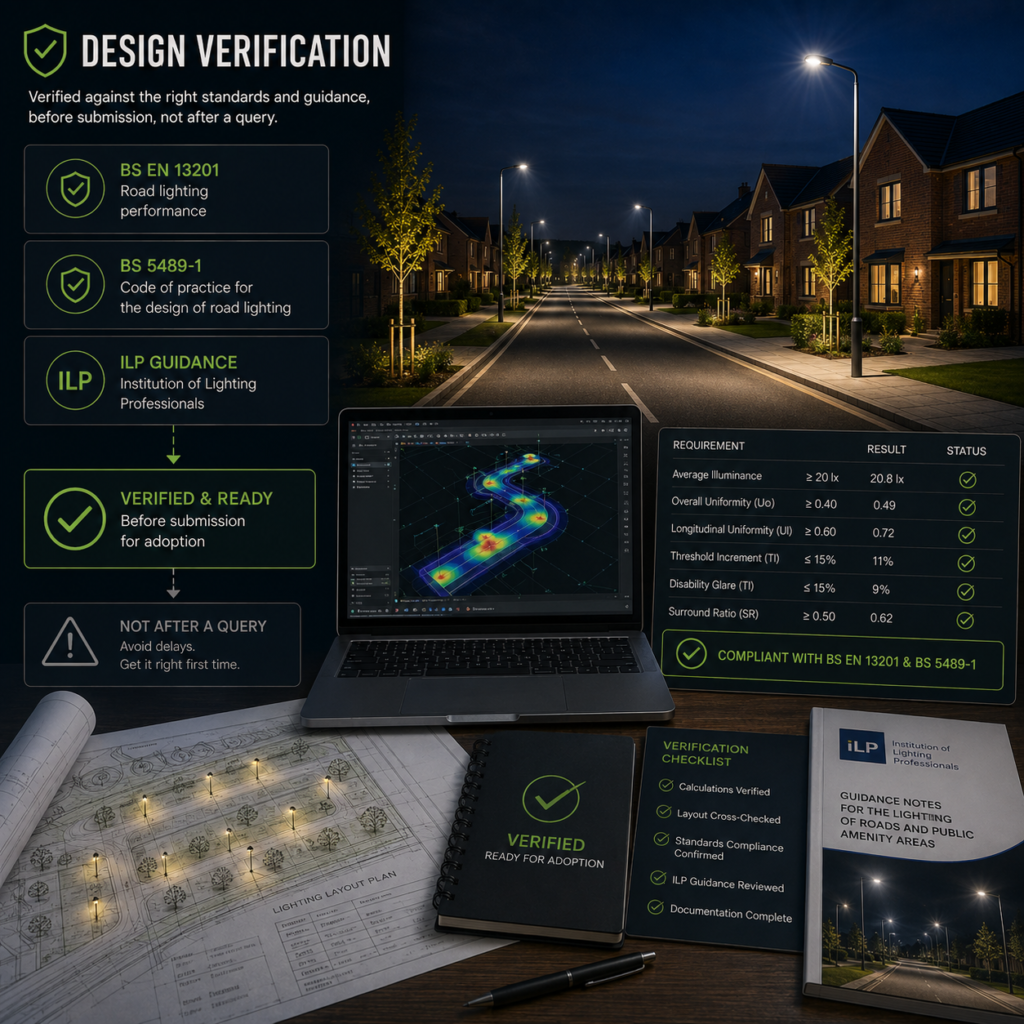
Calculations and layout are checked against BS EN 13201 and BS 5489-1, and cross-checked against ILP (Institution of Lighting Professionals) guidance, before issue. This verification step happens before the scheme is submitted for adoption, not after a query comes back from the authority.
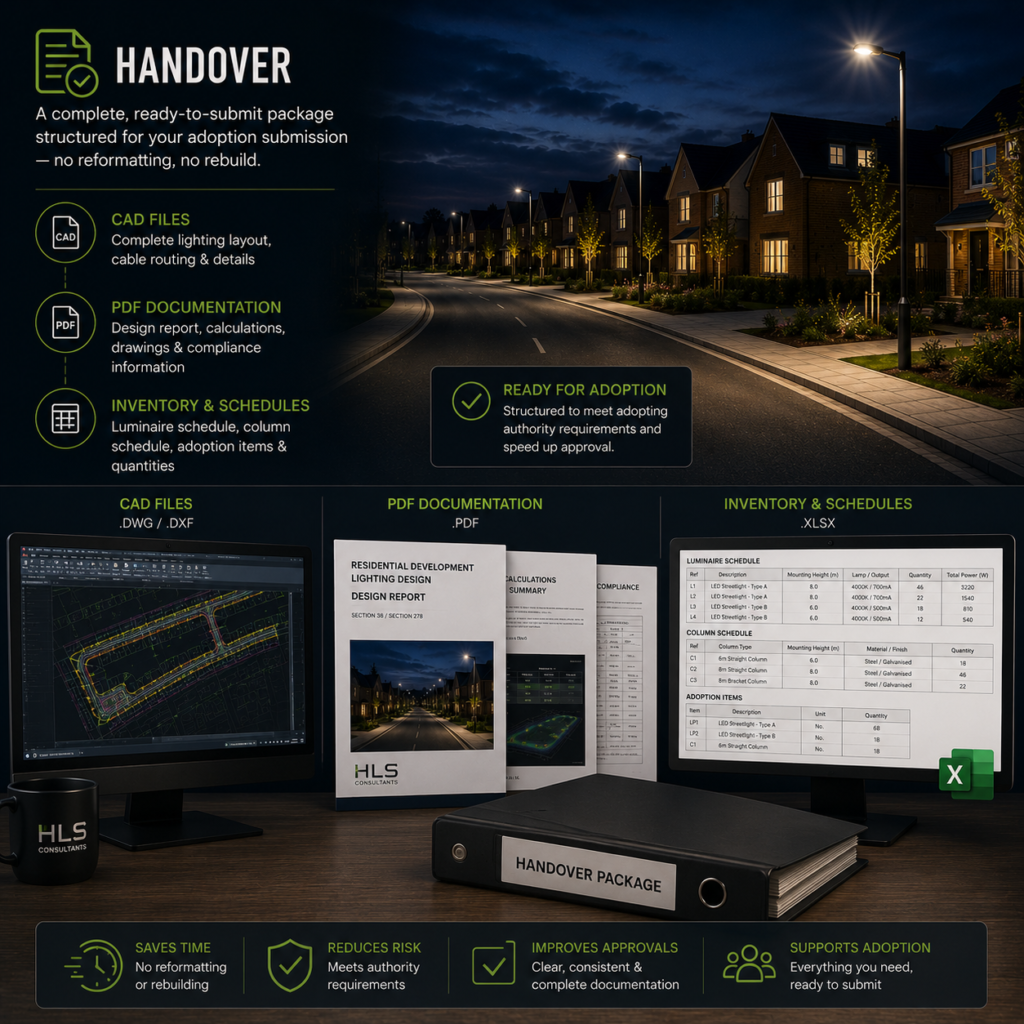
The final documentation package is issued in CAD files, PDF documentation, and inventory/schedule data in spreadsheet format — structured to be used directly in your adoption submission, without your team needing to reformat or rebuild it first.
HLS Consultants designs to the specific classification and adoption framework relevant to each region, rather than applying a single generic standard across every market:
BS 5489-1 and BS EN 13201, applied to Section 38 (developer-led adoptable roads) and Section 278 (highway works agreements) lighting design under the Highways Act framework
BS 5489-1 and BS EN 13201, applied to developer-led residential road and lighting design intended for local authority adoption
Lighting design calculated to BS EN 13201 classification principles, coordinated with the residential and community development requirements of the relevant local authority
ILP (Institution of Lighting Professionals) guidance notes, applied as a technical benchmark across all three regions
Confirming the governing standard and the specific adopting authority's expected format with you at the outset of every engagement means there's no ambiguity later — the scheme is designed once, to the right standard, rather than adjusted after a query comes back.
Residential development lighting design work reaches us through several different routes, and we structure the engagement around how you actually need to use the output.
We provide S38/S278 design capacity for developer-side schemes running through detailed design and adoption, without pulling your own team off other live work.

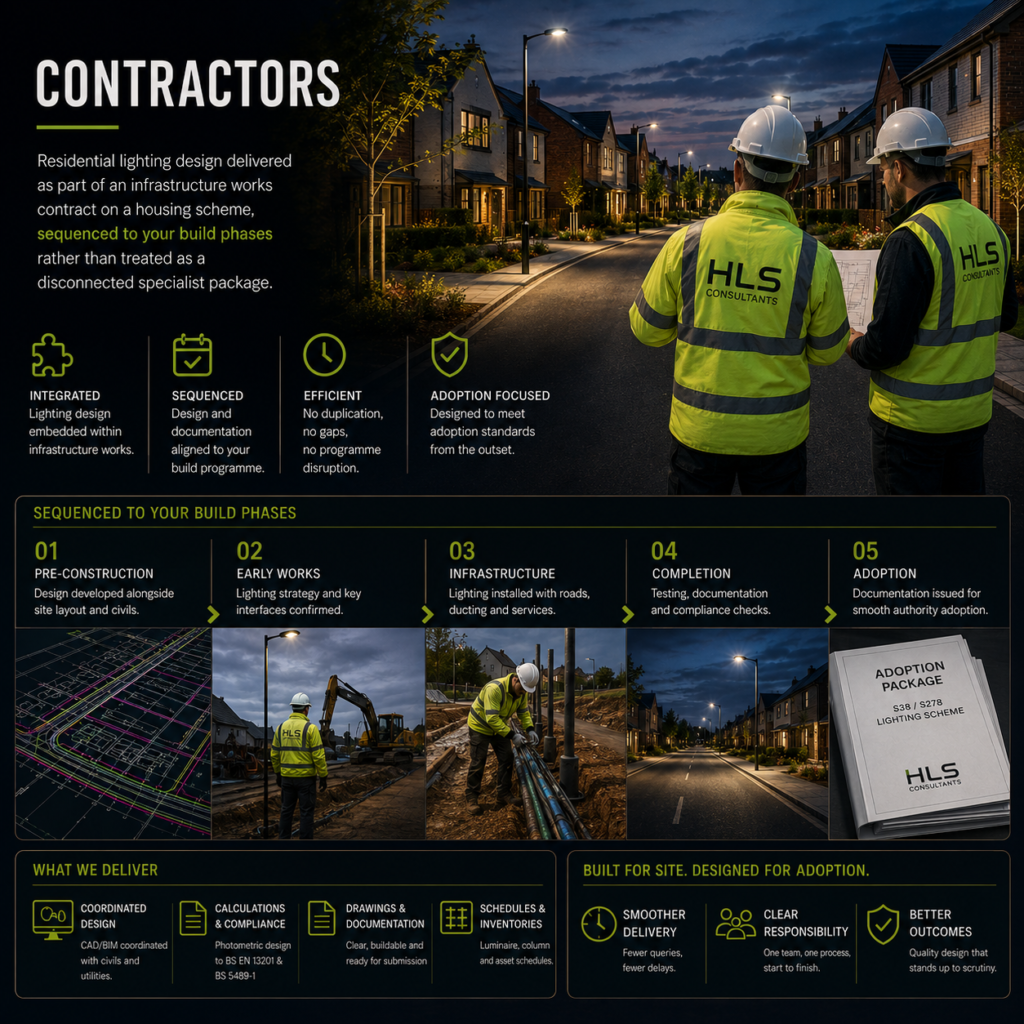
Residential lighting design is delivered as part of an infrastructure works contract on a housing scheme, sequenced to your build phases rather than treated as a disconnected specialist package.
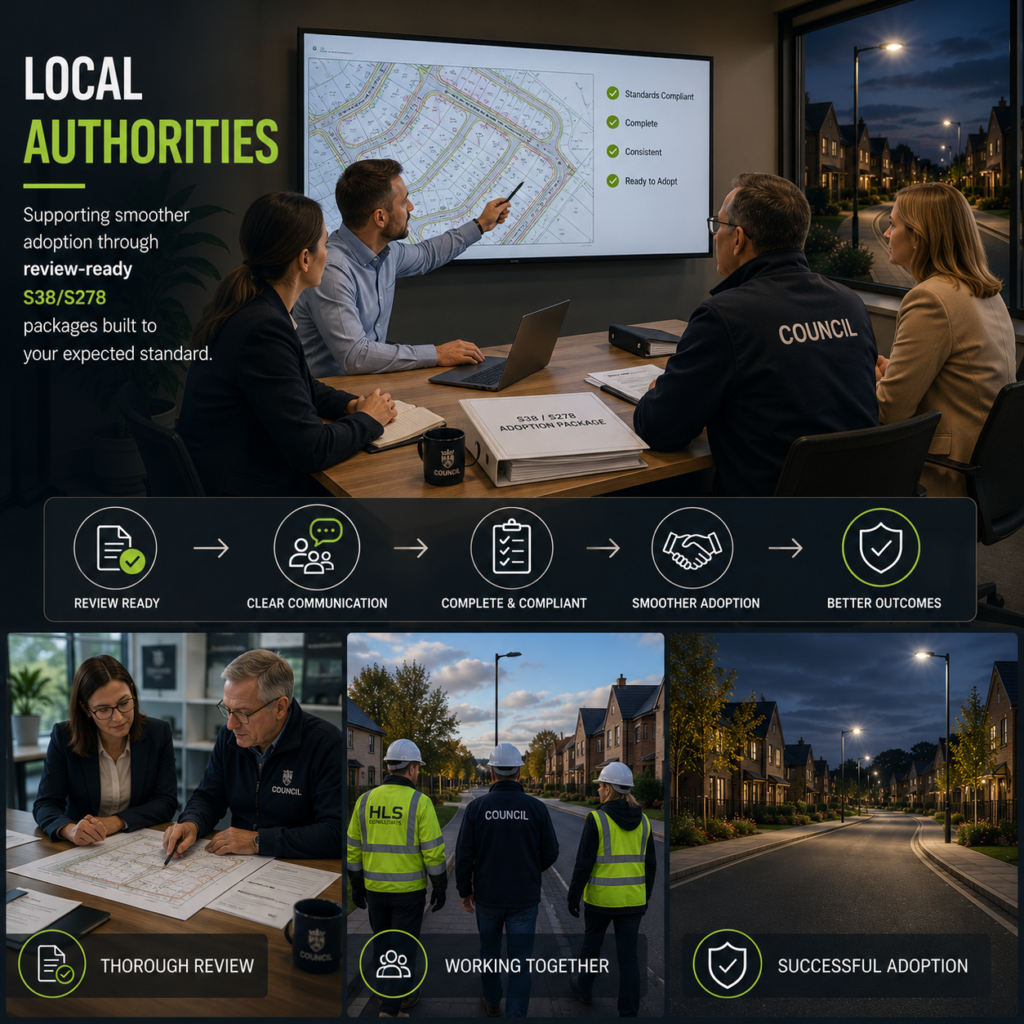
We support review-ready S38/S278 adoption packages built to your expected standard from the outset, cutting down the back-and-forth that comes from inconsistent developer submissions.
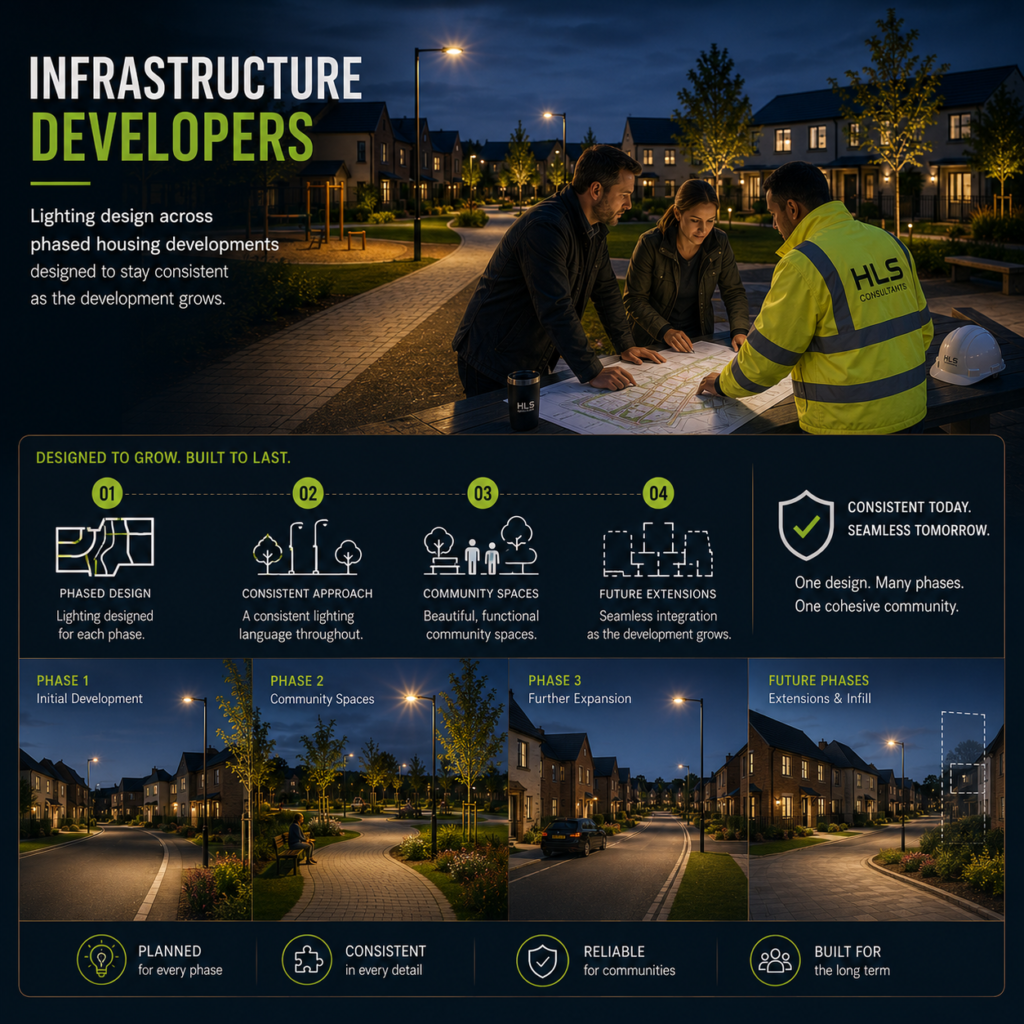
We deliver lighting design across phased housing developments including community spaces and later-phase extensions to an already-adopted scheme designed to stay consistent as the development grows.
We provide S38/S278 design capacity for developer-side schemes running through detailed design and adoption, without pulling your own team off other live work.

Section 38 covers lighting for new roads a developer intends to have adopted by the local authority. Section 278 covers lighting works tied to modifications of the existing public highway under an agreement with the authority. Both follow the same technical standards, but the documentation and sign-off path differ — we structure the submission to match whichever route applies to your scheme.
Yes - S38/S278 lighting design typically needs to align with drainage, road geometry, and utility layouts. We coordinate directly with your civils team to avoid clashes before submission.
We build the calculation and documentation package against the authority's expected standard from the outset — BS 5489-1, BS EN 13201, and ILP guidance — rather than adjusting after a first-round query.
Section 38 and Section 278 are specific to UK highways legislation. For Ireland, we design residential development lighting to BS 5489-1 and BS EN 13201 within the local authority's own developer-led adoption process. For the Middle East, we design to BS EN 13201 classification principles, coordinated with the relevant local authority's residential development requirements.
No - we work from client-supplied topographical and GPR survey data plus desktop assessment using aerial and mapping data. Where a physical visit is genuinely required, we coordinate it through our delivery partners in the UK and Ireland on a chargeable basis.
We're a design consultancy - fixture supply, installation, electrical connection works, and the authority's post-adoption maintenance inspection sit outside our scope. What you receive is CAD files, PDF documentation, and inventory/schedule data in spreadsheet format, structured to be adoption-ready.
Yes. We design later phases to align with the existing adopted infrastructure wherever possible, flagging only where current classification requirements genuinely require a change from the earlier phase's design, rather than defaulting to a full redesign that creates inconsistency across the development.
Partner with HLS Consultants for expert lighting design, backed by electrical design and CAD/BIM expertise.
B-128, Ist Floor, Sector 2, Noida, Gautam Buddha Nagar- 201301, Uttar Pradesh
Copyrights© 2026 HLS Consultants (OPC) Pvt. Ltd. (CIN: U71100UW2026OPC256882). All rights reserved.
Loading...