













Highway Electrical Design Built to Reduce Connection Risk

Electrical Infrastructure, Feeder Pillars & Power Networks — UK, Ireland & Middle East

Engineering reliable electrical infrastructure for highway lighting systems, including feeder pillars and power networks. Our calculation-led designs are developed to meet project and utility requirements while reducing the risk of technical rework, approval issues, and connection delays.

A highway lighting scheme is only as reliable as the electrical infrastructure feeding it. A feeder pillar undersized for the load, a power network laid out without accounting for future capacity, or a design that doesn't match the connecting utility's requirements doesn't just risk its own rejection — it can hold up energisation of an otherwise-complete lighting scheme. HLS Consultants is a specialist highway electrical design consultancy, providing calculation-led electrical infrastructure design for feeder pillars and power networks across the United Kingdom, Ireland, and the Middle East

Whether you're an engineering consultancy needing electrical design capacity alongside a live highway lighting scheme, a Tier 1 contractor delivering the electrical infrastructure package for a highway contract, a local authority replacing ageing feeder pillar networks, or an infrastructure developer whose lighting scheme depends on new electrical infrastructure, our highway electrical design service is built around one outcome: a power network and feeder pillar design engineered to reduce the risk of rework or connection delay at review.

What Our Highway Electrical Design Service Covers

HLS Consultants is a design-only electrical consultancy — we do not supply feeder pillars or switchgear, and we do not carry out installation or the physical utility connection. What we deliver is the technical backbone of a compliant electrical infrastructure scheme: the design, the calculations, the verification, and the documentation your team, contractor, or utility needs to move a scheme toward energisation.

Our highway electrical design service covers feeder pillar specification, power network layout, and cable routing for highway and street lighting schemes, for both new build schemes and replacement or upgrade of ageing electrical infrastructure — including capacity upgrades where a network is being modernised alongside an LED lighting conversion. This service can be delivered standalone, where the lighting layout is already fixed, or bundled with our Highway & Street Lighting design service as one coordinated package.

Why Professional Highway
Electrical Design Matters

Feeder pillars and power networks sit at the point where a lighting scheme's design meets the realities of load capacity, cable sizing, and the connecting utility's own technical requirements. A network calculated conservatively wastes capacity and cost; one calculated without headroom for future connections or LED-driven load changes can require costly rework the moment the scheme needs to expand. Get the wiring standard or the utility's expected documentation format wrong, and a technically sound design can still stall at the connection stage, holding up energisation of a lighting scheme that's otherwise ready to go live.

This is the gap a specialist highway electrical design consultancy closes. HLS Consultants calculates load and cable sizing against the actual lighting network it's feeding, and designs to the specific wiring standard and utility documentation format your region requires, rather than treating electrical infrastructure as a generic add-on to the lighting scheme.

Electrical infrastructure is also where a lighting scheme's programme risk often actually sits. A lighting design can be fully calculated, verified, and ready to issue, but if the feeder pillar and power network design lags behind or is documented to the wrong utility format, the whole scheme waits on the connection. Treating electrical design as a parallel, equally rigorous workstream — rather than an afterthought once the lighting layout is finished — reduces the risk of the connection becoming the bottleneck for the whole scheme's programme.

New Build vs. Replacement and Upgrade of Ageing Infrastructure

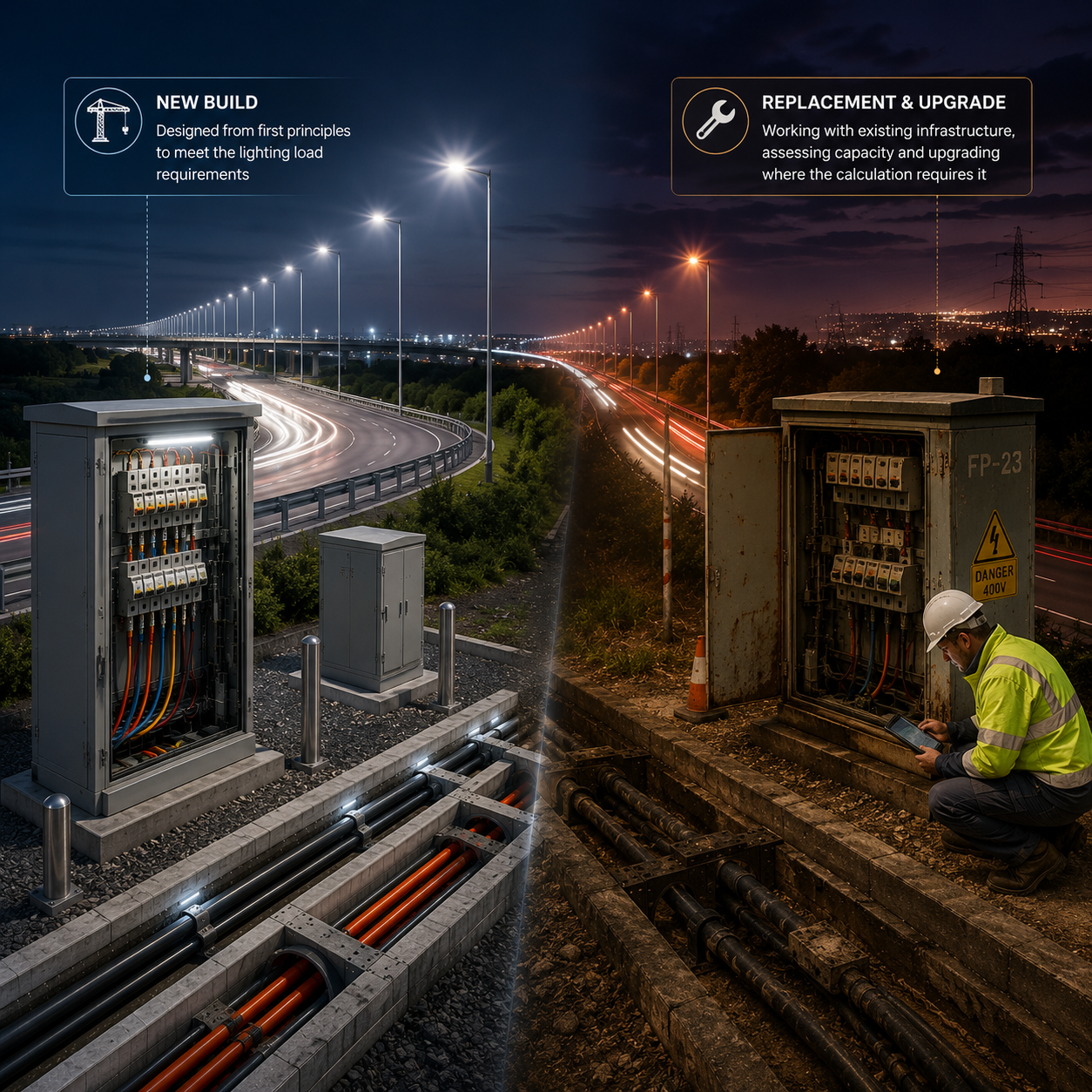
Highway electrical design generally falls into one of two categories. New build schemes — a new road, a new lighting network — start from a clean design brief, where feeder pillar positions and power network layout are calculated directly from the lighting scheme's load requirements. Replacement and upgrade schemes start from an existing electrical network, often one installed before an LED conversion reduced the connected load, or one with feeder pillars approaching the end of their service life.

HLS Consultants designs for both. On new build schemes, we calculate the power network and feeder pillar specification from the lighting load and cable routing from first principles. On replacement and upgrade schemes — including capacity reviews following an LED conversion — we design around the existing network infrastructure wherever possible, flagging where a genuine change in feeder pillar position, cable sizing, or capacity is required by the calculation rather than defaulting to a full network redesign.

Common Highway Electrical Design Challenges We Solve

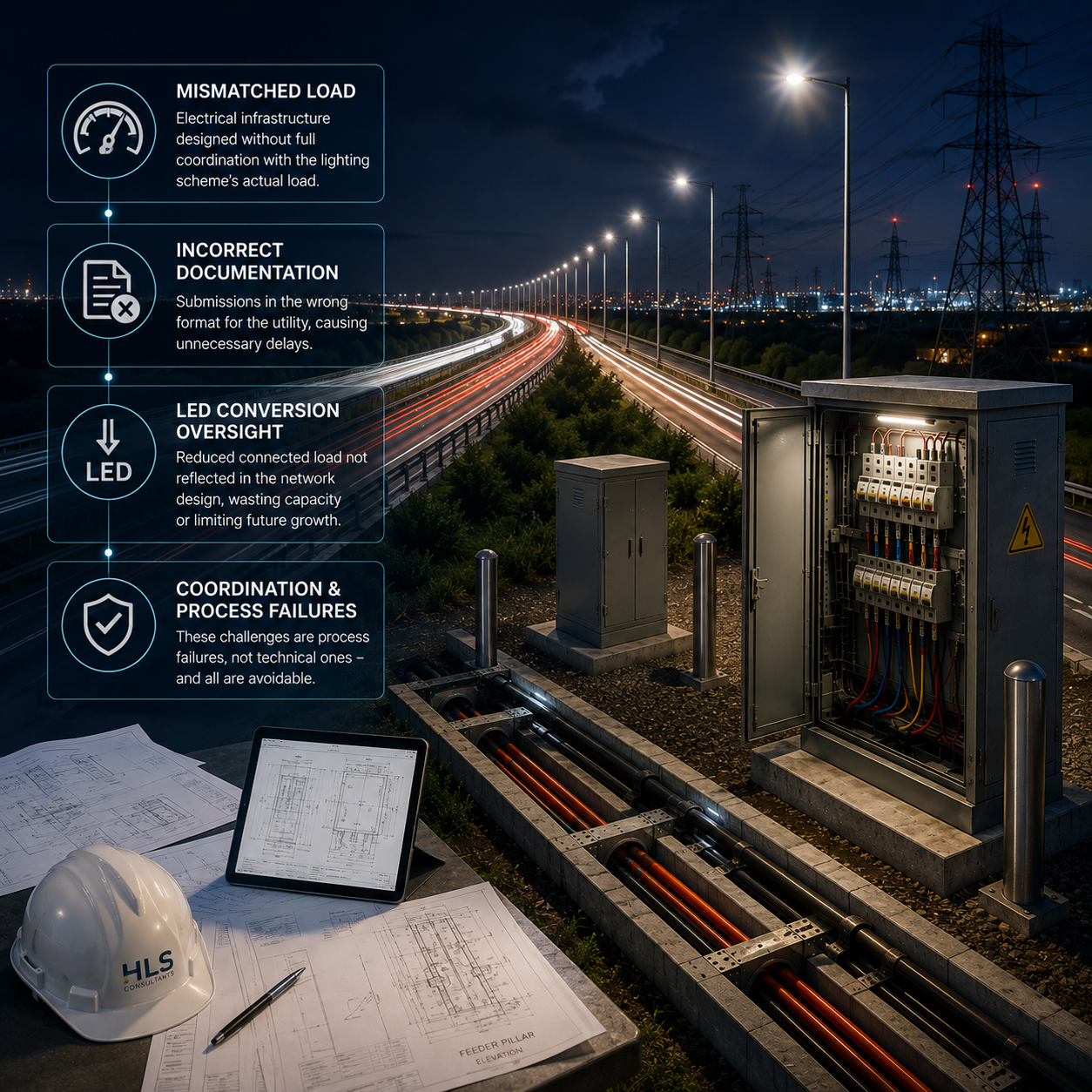
Highway electrical design schemes tend to run into a similar handful of problems, regardless of region. Electrical infrastructure is designed without full coordination with the lighting scheme's actual load, and the feeder pillar is sized for the wrong demand. A submission is documented in a format the connecting utility doesn't recognise, creating a connection delay that has nothing to do with the underlying design quality. An LED conversion reduces the connected load on an existing network, but the feeder pillar and cable sizing from the original design are carried over unchanged, leaving capacity that's either wasted or, in some cases, undersized for future expansion.

Each of these is a coordination or process failure, not a technical one — and each is avoidable with a design process that calculates load directly from the lighting scheme it serves, documents to the specific utility's expected format, and reviews capacity properly whenever the connected load changes. That's the process HLS Consultants applies to every highway electrical design scheme, regardless of scale or region.

Our Highway Electrical Design Process

Every highway electrical design scheme we design follows the same structured, verifiable process — from the survey data you provide through to a fully checked documentation package ready for submission.

Survey Data Intake

You supply topographical and GPR survey data, alongside the lighting scheme’s load requirements. We carry out desktop assessment using aerial and mapping data to confirm route and existing infrastructure — no site visit is required from HLS directly. This keeps the design process fast to start and easy to run alongside your own team’s workload.

Electrical Design & Network Layout

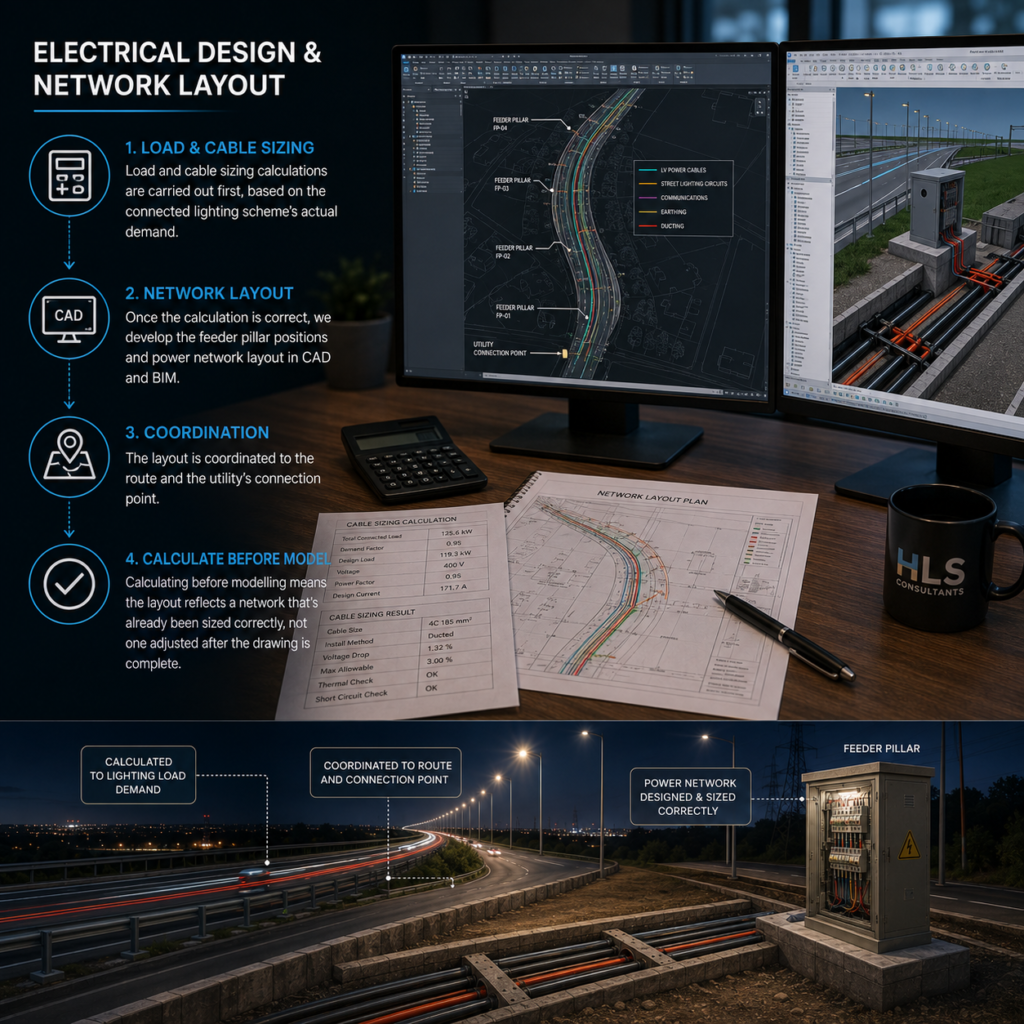
Load and cable sizing calculations are carried out first, based on the connected lighting scheme’s actual demand. Only once the calculation is correct do we develop the feeder pillar positions and power network layout in CAD and BIM, coordinated to the route and the utility’s connection point. Calculating before modelling means the layout reflects a network that’s already been sized correctly, not one adjusted after the drawing is complete.

Feeder Pillar Specification

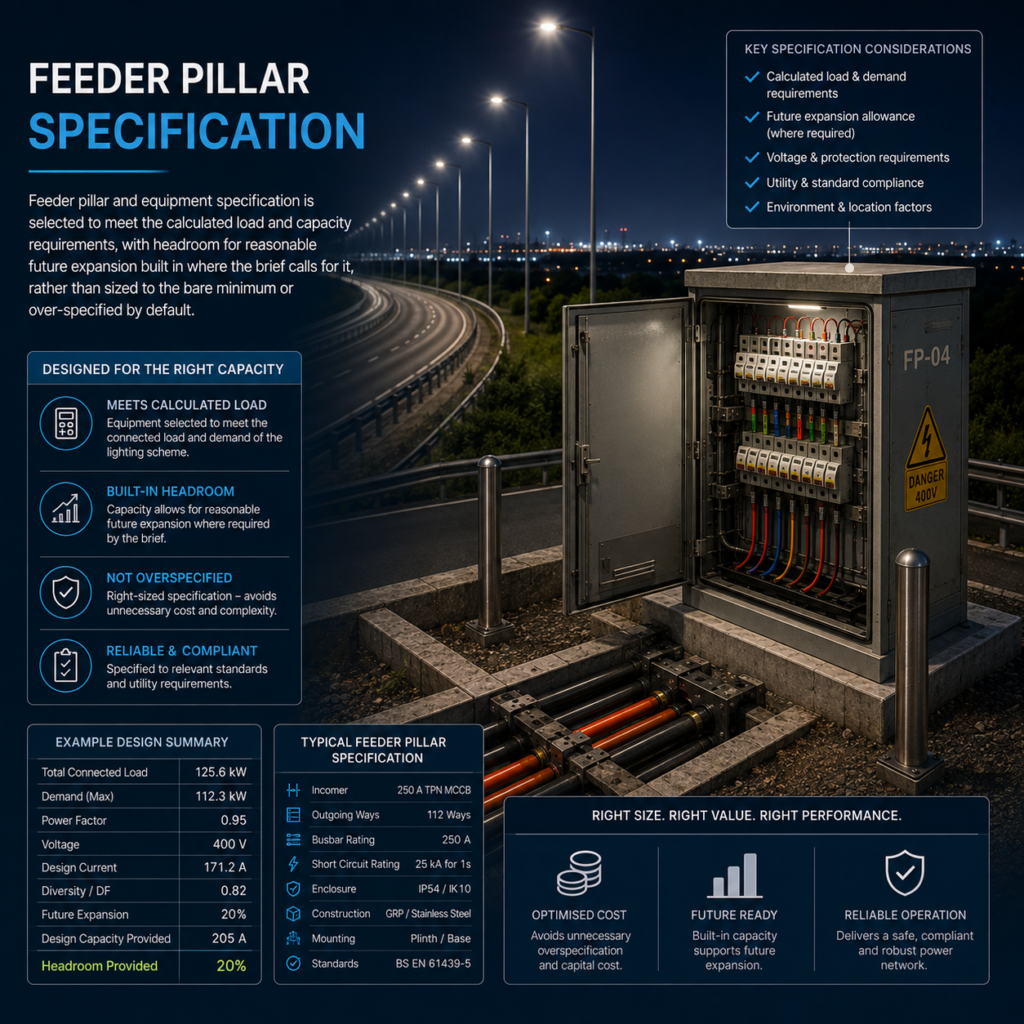
Feeder pillar and equipment specification is selected to meet the calculated load and capacity requirements, with headroom for reasonable future expansion built in where the brief calls for it, rather than sized to the bare minimum or over-specified by default.

Design Verification

Calculations and layout are checked against the relevant wiring standard for your region and the connecting utility’s technical requirements, before issue. This verification step happens before the scheme is submitted, not after a connection query comes back.

Handover

The final documentation package is issued in CAD files, PDF documentation, and inventory/schedule data in spreadsheet format — structured to be used directly in your submission or utility connection process, without your team needing to reformat or rebuild it first.

Architectural Lighting Standards We Design To — UK, Ireland & Middle East

HLS Consultants designs to the guidance relevant to architectural and facade lighting in each region, rather than applying a single generic standard across every market:

Confirming the governing wiring standard and the specific connecting utility's expected format with you at the outset of every engagement means there's no ambiguity later — the network is designed once, to the right standard, rather than adjusted after a connection query comes back.

Who We Work With

We partner with organisations delivering complex infrastructure projects.

Highway electrical design work reaches us through several different routes, and we structure the engagement around how you actually need to use the output.

Engineering Consultancies
01

Engineering Consultancies

We provide electrical design capacity alongside a live highway lighting scheme, calculating feeder pillar and power network requirements to the same standard your own team would apply if resourced to take it on internally.

02

Tier 1 Contractors

Highway electrical design is delivered as the electrical infrastructure package within a wider highway construction contract, sequenced to your build programme rather than delivered as a disconnected specialist workstream.

Tier 1 Contractors
02

Tier 1 Contractors

Highway electrical design is delivered as the electrical infrastructure package within a wider highway construction contract, sequenced to your build programme rather than delivered as a disconnected specialist workstream.

03

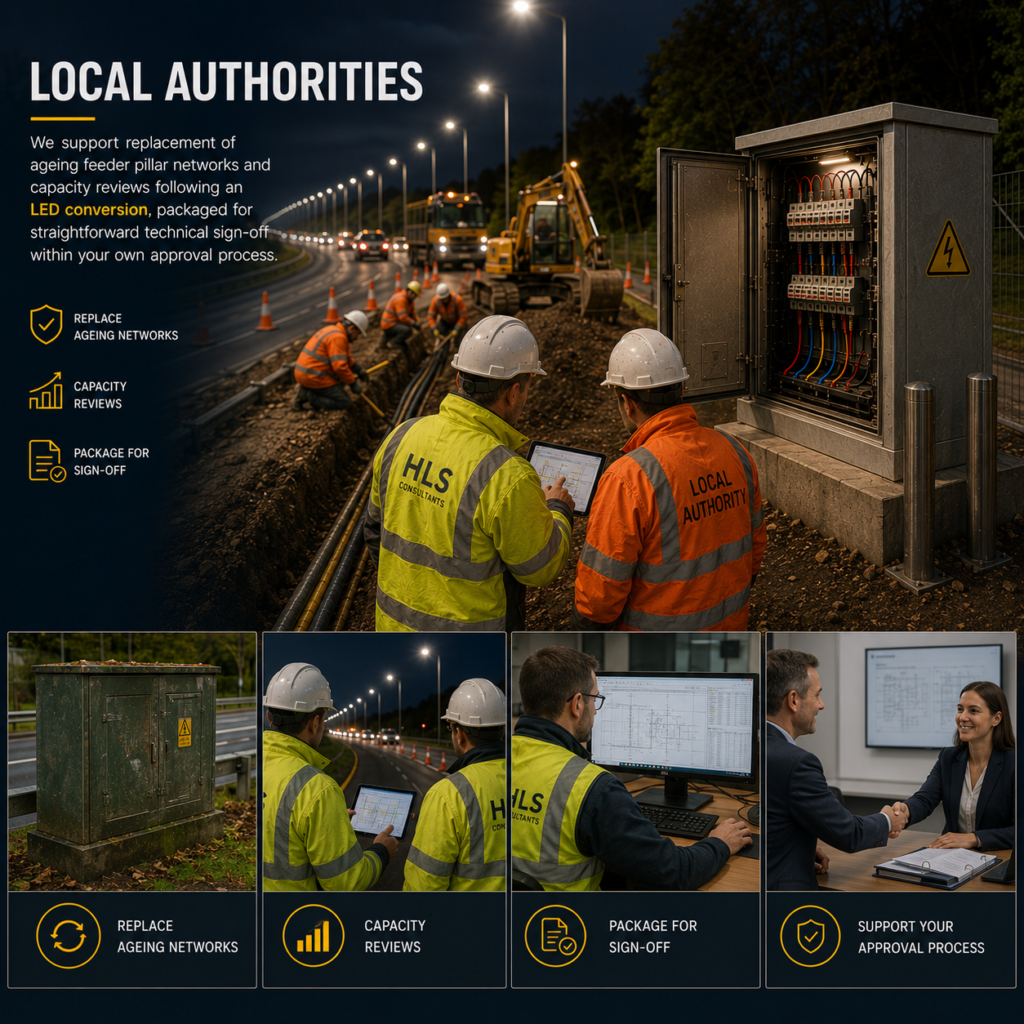
Local Authorities

We support replacement of ageing feeder pillar networks and capacity reviews following an LED conversion, packaged for straightforward technical sign-off within your own approval process.

Local Authorities
03

Local Authorities

We support replacement of ageing feeder pillar networks and capacity reviews following an LED conversion, packaged for straightforward technical sign-off within your own approval process.

04

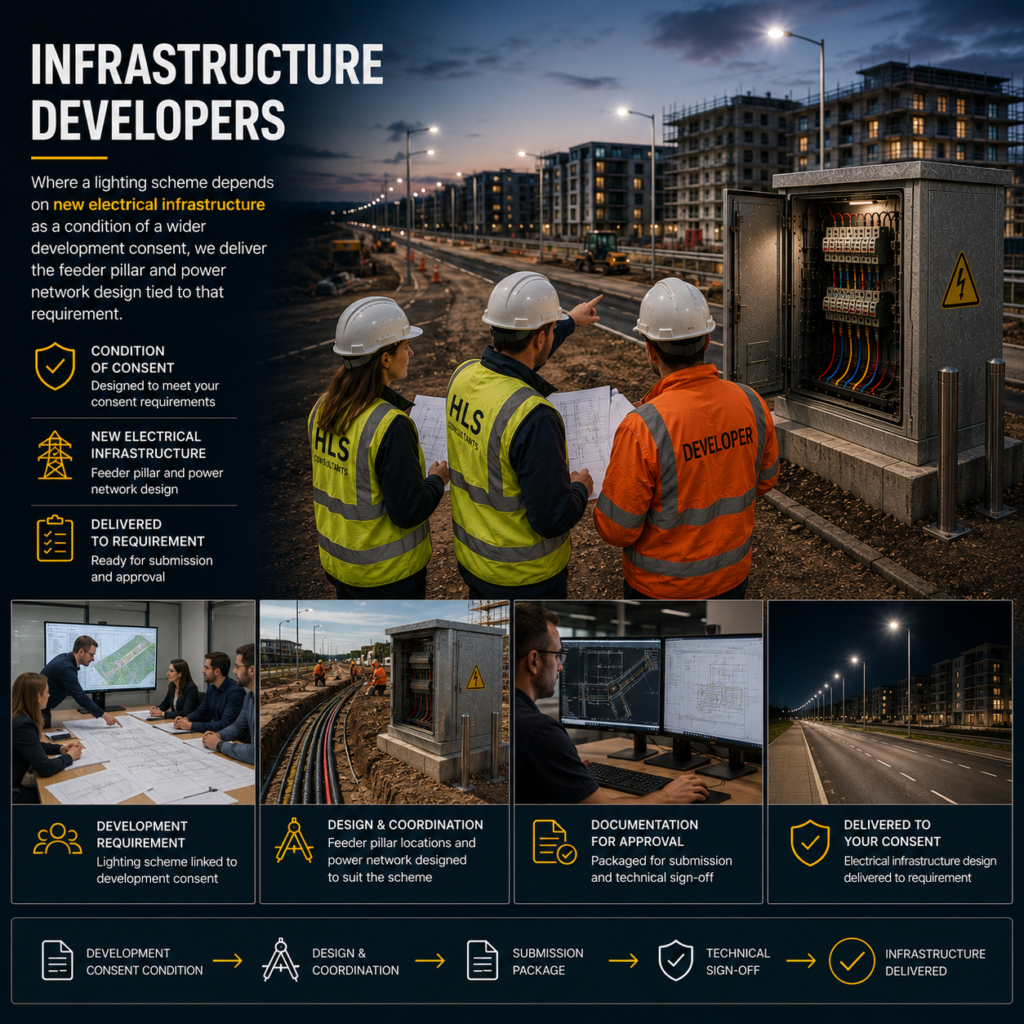
Infrastructure Developers

Where a lighting scheme depends on new electrical infrastructure as a condition of a wider development consent, we deliver the feeder pillar and power network design tied to that requirement.

Infrastructure Developers
04

Infrastructure Developers

Where a lighting scheme depends on new electrical infrastructure as a condition of a wider development consent, we deliver the feeder pillar and power network design tied to that requirement.

01

Engineering Consultancies

We provide electrical design capacity alongside a live highway lighting scheme, calculating feeder pillar and power network requirements to the same standard your own team would apply if resourced to take it on internally.
01 02 03 04
Scroll to Explore
Faq’s

Your Queries, Our Answers

Is this offered as a standalone service, or only bundled with lighting design?

Both — it's available standalone, for schemes where the lighting layout is already fixed and only the electrical infrastructure needs designing, or bundled with our Highway & Street Lighting design service as one coordinated package.

What standards govern the electrical design for UK, Irish, and Middle East schemes?

UK schemes are designed to BS 7671 (IET Wiring Regulations), coordinated with the relevant Distribution Network Operator. Irish schemes are designed to ET 101 (National Rules for Electrical Installations), coordinated with the relevant Irish network operator. Middle East schemes are coordinated with the wiring regulations and connection requirements of the relevant local utility provider.

We're converting an existing network to LED — do we need to review the feeder pillar and cable sizing?

Yes, generally. An LED conversion usually reduces the connected load, which can leave the original feeder pillar and cable sizing oversized for the new demand — or, in some cases, no longer matched to what the network now needs. We review capacity as part of any upgrade scheme rather than carrying the original sizing over unchanged.

Do you handle the utility connection application, or just the design?

We design only — the feeder pillar and power network design, calculations, and documentation. The connection application and physical installation sit with your team, contractor, or the connecting utility.

Do you need to visit the site before designing the electrical infrastructure?

No — we work from client-supplied topographical and GPR survey data plus the lighting scheme's load requirements. Where a physical visit is genuinely required, we coordinate it through our delivery partners in the UK and Ireland on a chargeable basis.

What do we actually receive at handover?

CAD files, PDF documentation, and inventory/schedule data in spreadsheet format — structured to be used directly in your submission or utility connection process.

Can you design electrical infrastructure for a scheme that spans more than one region, such as a cross-border route?

Yes. Because we design each section to its own governing wiring standard — BS 7671 where the network sits in the UK, ET 101 where it sits in Ireland — a scheme that crosses regions is handled as two correctly-specified networks joined at the boundary, rather than one standard stretched across both.

if you still have any questions

×

Loading...