








B-128, Ist Floor, Sector 2, Noida, Noida,
Gautam Buddha Nagar- 201301, Uttar Pradesh

Lighting Impact Assessment Built to Reduce Planning and Ecological Risk

Obtrusive Light, Light Pollution & Ecological Lighting Assessment — UK, Ireland & Middle East

Providing specialist lighting impact assessments for obtrusive light, light pollution, and ecological lighting impacts across the UK, Ireland, and Middle East. Our assessment-led approach evaluates lighting proposals against the relevant environmental zones and sensitive receptors, helping identify potential planning and ecological issues early and support smoother project approval.

Artificial light is one of the most commonly challenged elements of a planning application, and one of the most commonly under-prepared for. A scheme that hasn't assessed its obtrusive light against the site's environmental zone, or hasn't considered its effect on bats and other sensitive ecological receptors, tends to surface as an objection late in the process — after a design is otherwise finished. HLS Consultants provides specialist lighting impact assessment: obtrusive light, light pollution, and ecological lighting impact assessment for planning applications and Environmental Impact Assessment submissions across the United Kingdom, Ireland, and the Middle East.

Whether you're an engineering or environmental consultancy needing lighting-specific input for an Environmental Statement, a Contractor or developer needing a standalone lighting impact assessment to support a planning application, or a local authority reviewing a submitted scheme's obtrusive light compliance, our service is built around one outcome: a lighting assessment calculated against the correct environmental zone and receptor sensitivity, engineered to reduce the risk of a planning objection or a late-stage ecological query.

What Our Environmental Impact Assessment (Lighting) Service Covers

HLS Consultants provides the lighting-specific component of environmental assessment — we are a lighting design consultancy, not a multi-disciplinary environmental consultancy, and we do not assess noise, air quality, traffic, or hydrology. What we deliver is the technical lighting input a wider Environmental Impact Assessment needs, or a standalone assessment where a full EIA isn't required but obtrusive light still needs addressing for planning.

Our service covers new development schemes going through planning or full EIA, and existing or operational schemes where obtrusive light compliance needs reviewing — for example, responding to a planning condition, a complaint, or a change in an ecological designation near the site. This makes the service equally relevant whether a lighting scheme is still at design stage and needs its impact assessed before submission, or an existing installation needs a compliance review against current guidance.

Why Professional Lighting Impact
Assessment Matters

Obtrusive light is judged against the environmental zone of the site — from intrinsically dark landscapes to high-brightness urban centres — and against the sensitivity of the receptors nearby: residential windows, ecological habitats, highways, and protected landscapes all carry different tolerances. Get the environmental zone or the receptor assessment wrong, and a scheme that looked straightforward on the lighting layout can still generate a planning objection, an ecologist's query, or a condition that delays discharge long after the rest of the application has been approved.

This is the gap a specialist lighting impact assessment closes. HLS Consultants assesses every scheme against its actual environmental zone and the sensitivity of its real receptors — including ecological receptors such as bats, where relevant — rather than applying a generic obtrusive light check that doesn't hold up against a planning officer's or ecologist's scrutiny.

New Development Assessment vs Existing Scheme Review

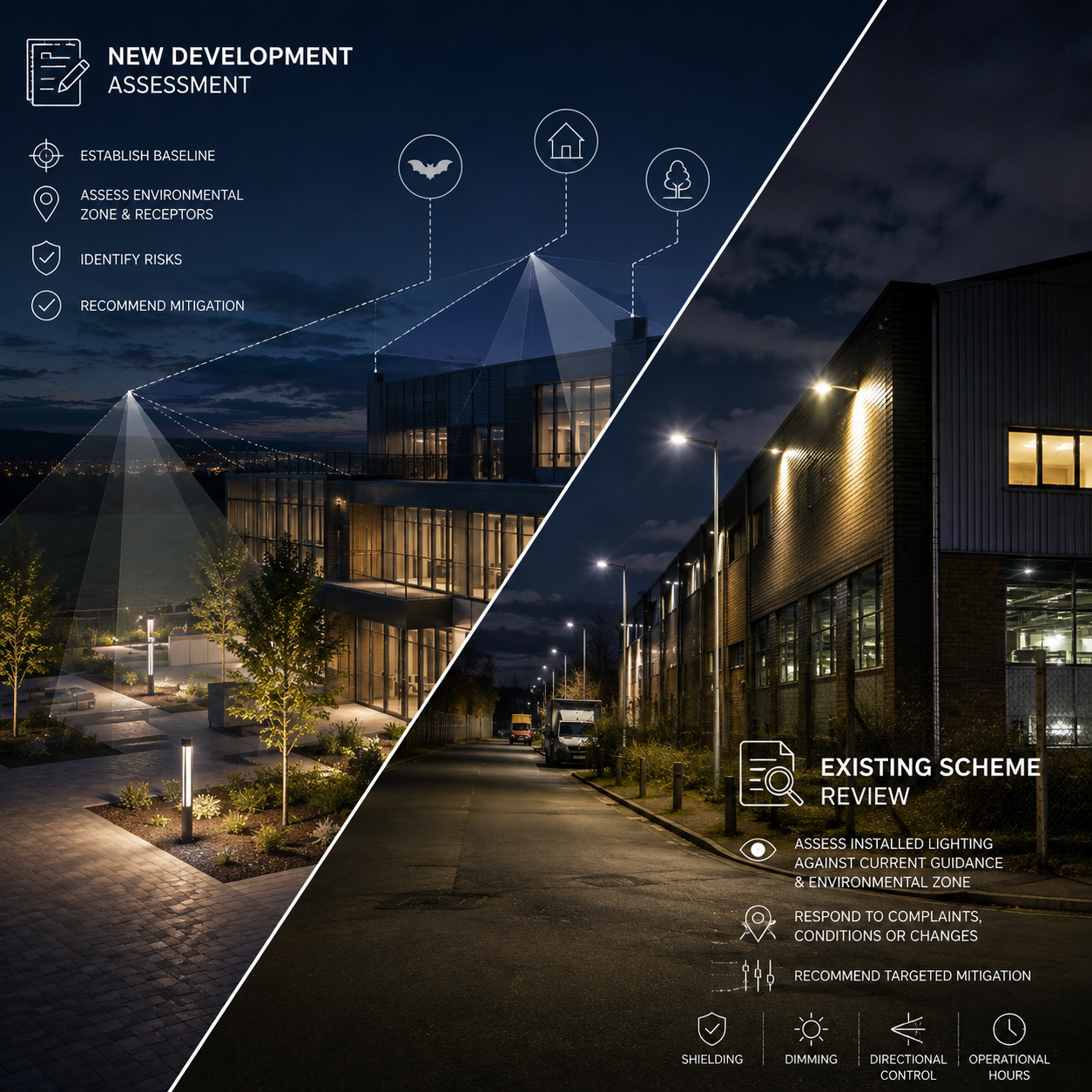
Lighting impact assessment generally falls into one of two categories. New development assessments support a planning application or Environmental Impact Assessment before a scheme is built — establishing the baseline, assessing the proposed lighting design against the site's environmental zone and receptors, and recommending mitigation where the assessment identifies a risk. Existing scheme reviews assess a lighting installation that's already built or already consented, often to discharge a planning condition, respond to a complaint, or address a change in ecological designation near the site since the original consent.

HLS Consultants covers both. On new development assessments, we work from the proposed lighting design and site data to establish baseline and assess impact before submission. On existing scheme reviews, we assess what's actually installed against current guidance and the site's environmental zone, recommending targeted mitigation — shielding, dimming, directional control, or operational hour changes — rather than assuming a full relighting scheme is the only route to compliance.

Common Lighting Impact Assessment Challenges We Solve

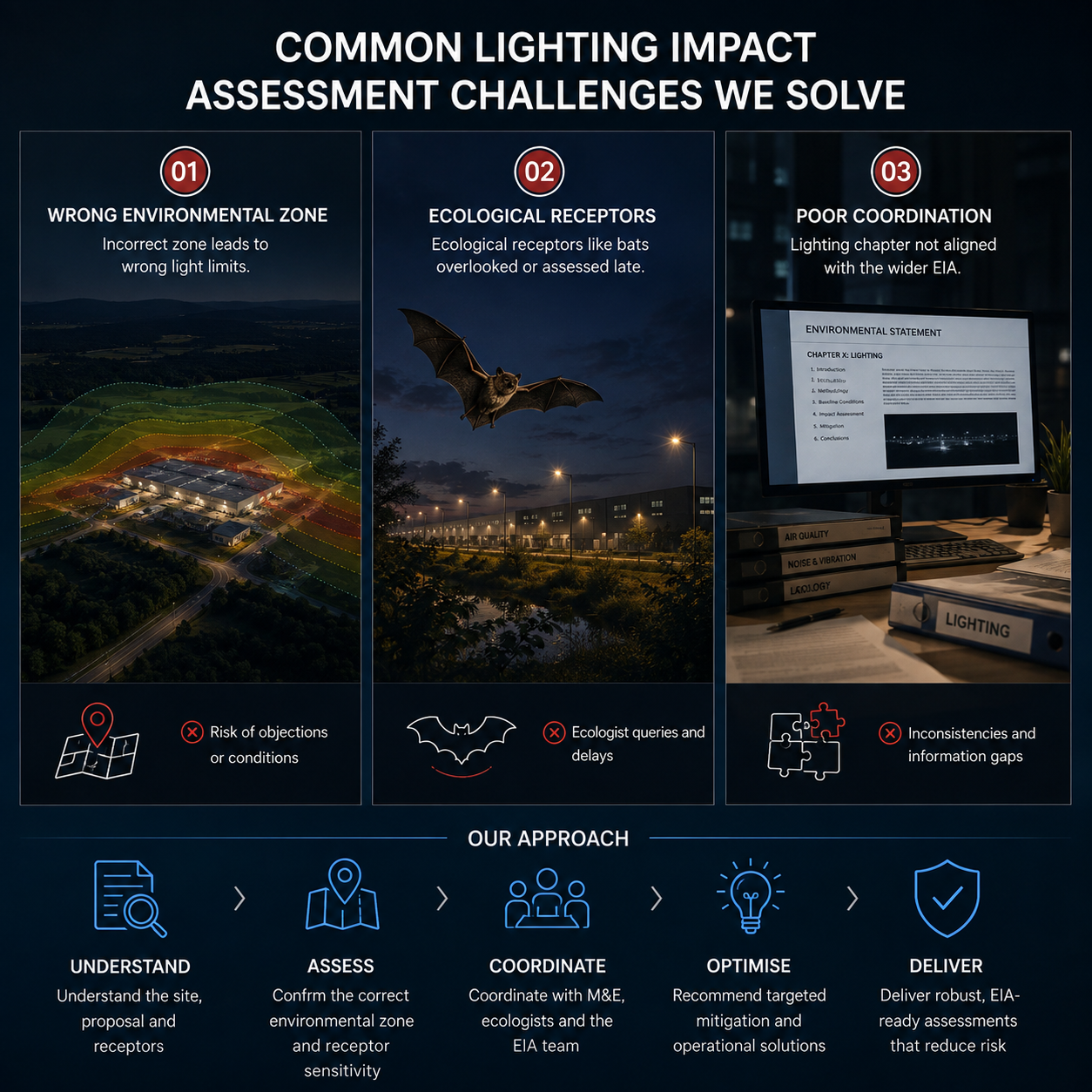
Lighting impact assessments tend to run into a similar handful of problems, regardless of region. A scheme is assessed against the wrong environmental zone, understating or overstating the obtrusive light limits that actually apply to the site. An assessment is submitted without considering ecological receptors — most commonly bats — and a planning authority's ecologist raises it as a query that could have been addressed at the design stage. A lighting chapter is written in isolation from the rest of the Environmental Statement, using terminology or a structure that doesn't align with how the lead environmental consultant has framed the wider assessment.

Each of these is a scoping or coordination failure, not a technical one — and each is avoidable with an assessment process that confirms the correct environmental zone and receptor sensitivity from the outset, considers ecological impact as standard rather than as an afterthought, and coordinates directly with the lead environmental consultant or ecologist where the assessment sits within a wider EIA. That's the process HLS Consultants applies to every lighting impact assessment, regardless of scale or region.

Our Lighting Impact Assessment Process

Every lighting impact assessment we produce follows the same structured, verifiable process — from the baseline data you provide through to a fully checked assessment ready for submission.

Baseline & Receptor Data Intake

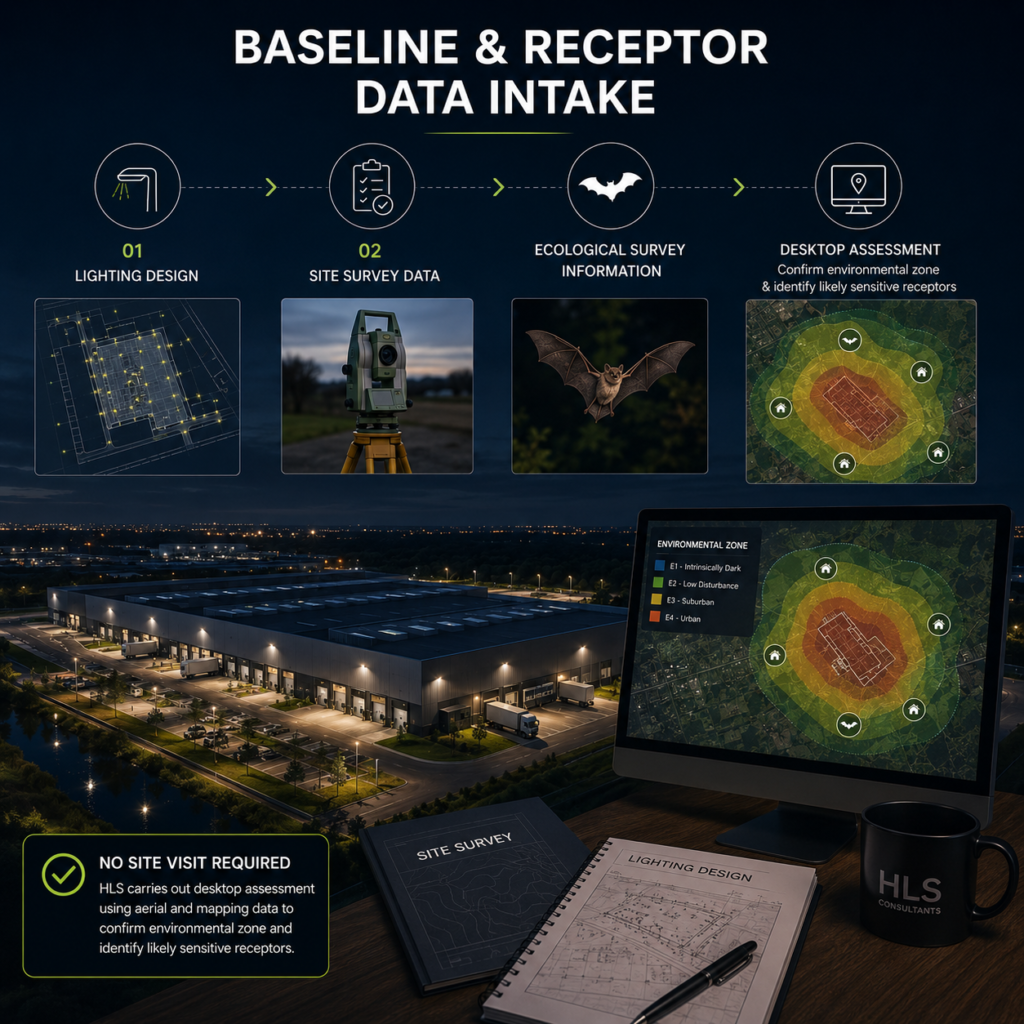
You supply the proposed or existing lighting design, site survey data, and any existing ecological survey information. We carry out desktop assessment using aerial and mapping data to confirm the site’s environmental zone and identify likely sensitive receptors — no site visit is required from HLS directly.

Impact Assessment & Reporting

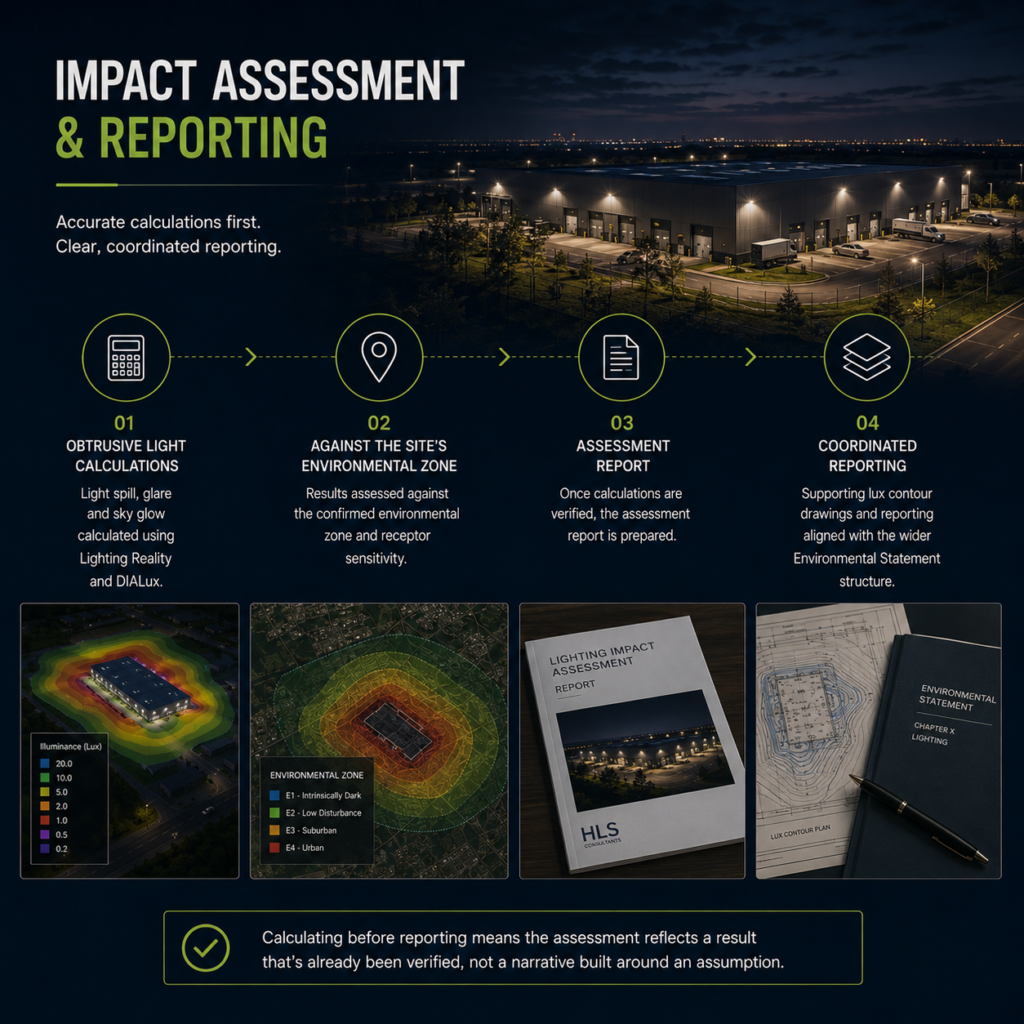
Obtrusive light calculations — light spill, glare, and sky glow — are carried out first, using Lighting Reality and DIALux, against the site’s environmental zone. Only once the calculation is correct do we develop the assessment report and any supporting lux contour drawings, coordinated with the wider Environmental Statement structure where relevant. Calculating before reporting means the assessment reflects a result that’s already been verified, not a narrative built around an assumption.

Mitigation Recommendations

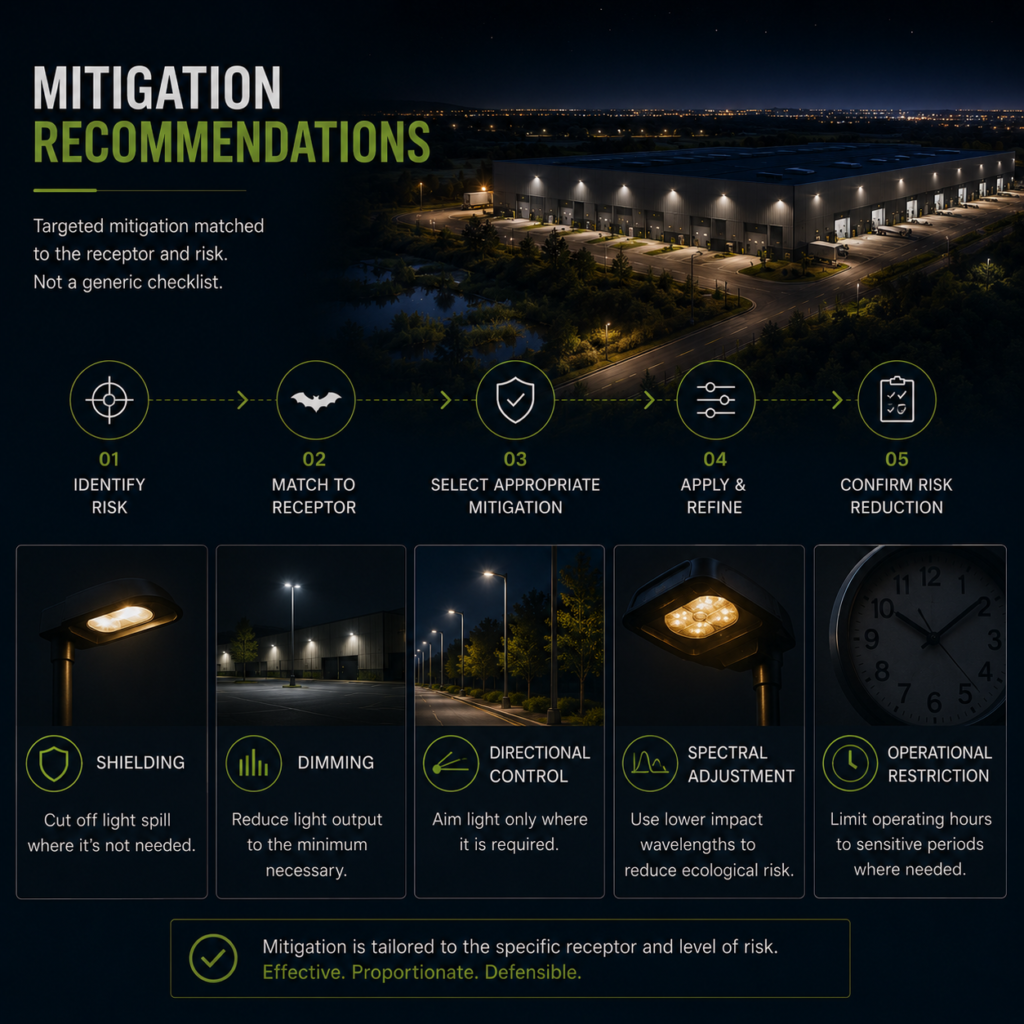
Where the assessment identifies a risk to a receptor, mitigation is recommended — shielding, dimming, directional control, spectral adjustment, or operational hour restriction — matched to what the specific receptor and risk actually require, rather than a generic mitigation list applied regardless of finding.

Design Verification

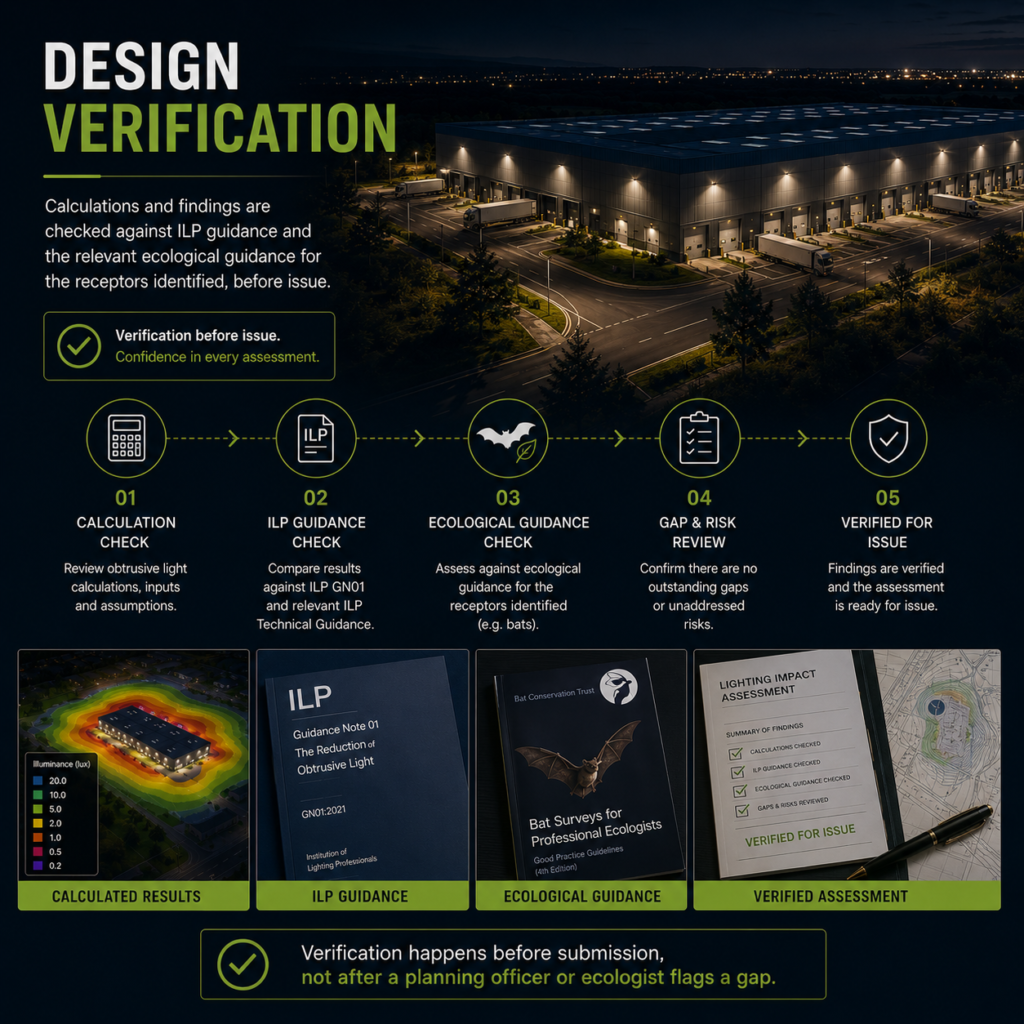
Calculations and findings are checked against ILP guidance and the relevant ecological guidance for the receptors identified, before issue. This verification step happens before the assessment is submitted, not after a planning officer or ecologist flags a gap.

Handover

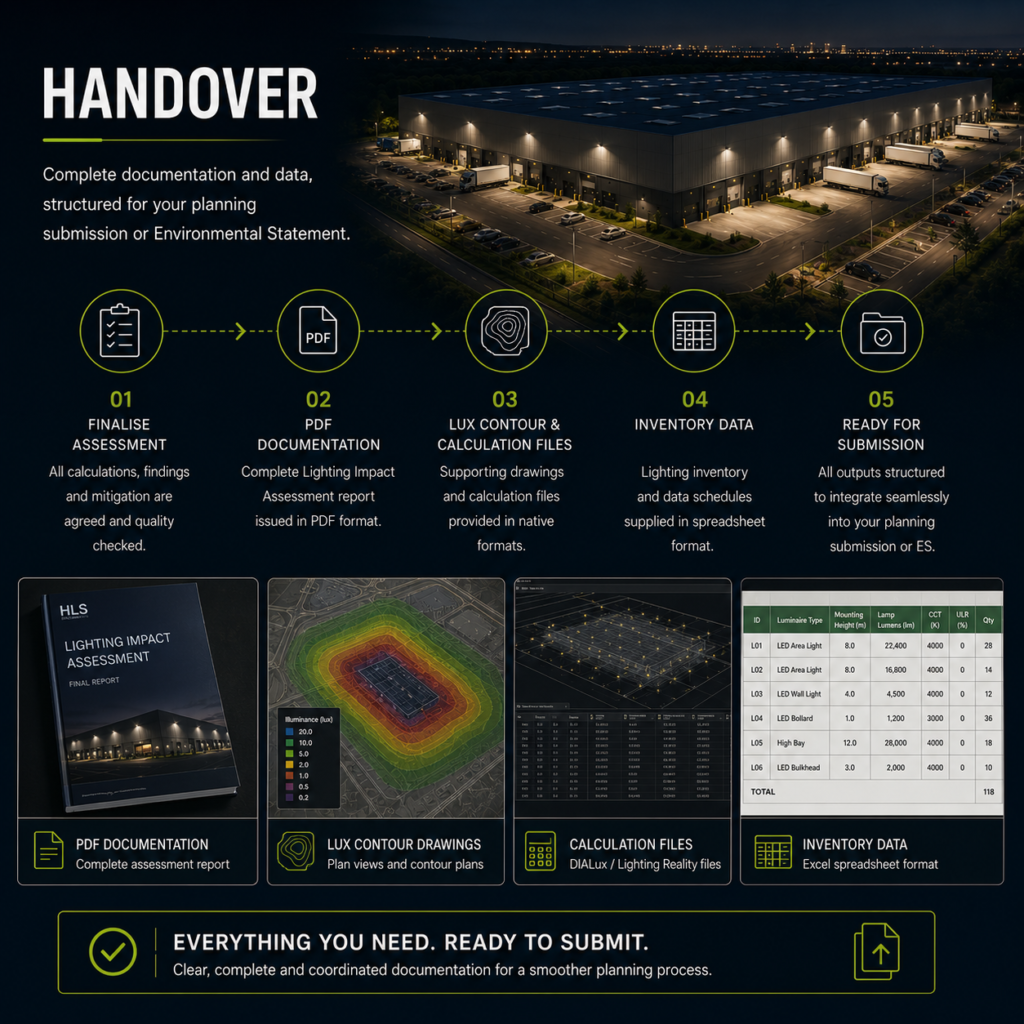
The final assessment is issued as PDF documentation, supporting lux contour and calculation files, and inventory data in spreadsheet format where relevant — structured to be used directly in your planning submission or Environmental Statement.

Industrial Lighting Standards We Design To — UK, Ireland & Middle East

HLS Consultants designs to the specific standards relevant to industrial and warehouse lighting in each region, rather than applying a single generic standard across every market

Confirming the site's environmental zone and the receptors relevant to your scheme with you at the outset of every engagement means the assessment is built once, against what the site actually requires, rather than adjusted after a planning officer or ecologist flags a gap.

Who We Work With

We partner with organisations delivering complex infrastructure projects.

Lighting impact assessment work reaches us through several different routes, and we structure the engagement around how you actually need to use the output.

Engineering & Environmental Consultancies
01

Engineering & Environmental Consultancies

We provide the lighting chapter or technical appendix for a wider Environmental Statement, coordinated with your lead environmental consultant’s structure and terminology rather than delivered as a disconnected report.


02

Contractors & Developers

We provide standalone lighting impact assessments to support a planning application where a full EIA isn’t required, or existing scheme reviews to discharge a lighting-related planning condition.

Contractors & Developers
02

Contractors & Developers

We provide standalone lighting impact assessments to support a planning application where a full EIA isn’t required, or existing scheme reviews to discharge a lighting-related planning condition.

03

Local Authorities

We support review of submitted schemes’ obtrusive light compliance, and assessment of existing installations following a complaint or a change in ecological designation near the site.

Local Authorities
03

Local Authorities

We support review of submitted schemes’ obtrusive light compliance, and assessment of existing installations following a complaint or a change in ecological designation near the site.

04

Infrastructure Developers

Where a development’s lighting scheme needs to be assessed as part of a wider planning submission, we deliver the lighting impact assessment alongside the lighting design itself, so both are built on the same underlying calculation.

Infrastructure Developers
04

Infrastructure Developers

Where a development’s lighting scheme needs to be assessed as part of a wider planning submission, we deliver the lighting impact assessment alongside the lighting design itself, so both are built on the same underlying calculation.

01

Engineering & Environmental Consultancies

We provide the lighting chapter or technical appendix for a wider Environmental Statement, coordinated with your lead environmental consultant’s structure and terminology rather than delivered as a disconnected report.

01 02 03 04
Scroll to Explore
Faq’s

Your Queries, Our Answers

Do you carry out full Environmental Impact Assessment, or just the lighting component?

Just the lighting component. HLS Consultants is a lighting design consultancy, not a multi-disciplinary environmental consultancy — we don't assess noise, air quality, traffic, or hydrology. We provide the obtrusive light and ecological lighting impact assessment, typically as a chapter or technical appendix within a wider Environmental Statement led by your environmental consultant.

Does the assessment cover ecological impacts such as bats?

Yes, where relevant — we assess potential impacts on bats and other sensitive ecological receptors in line with ILP and Bat Conservation Trust joint guidance, working alongside your ecologist where the site has an existing ecological survey or known sensitive species present.

Can a lighting impact assessment help support a planning application outside a full EIA?

Yes. Most UK and Irish planning authorities expect obtrusive light and light pollution to be properly assessed as part of any application involving external lighting, regardless of whether a full EIA is required. A standalone assessment demonstrates that impacts have been considered and mitigation addressed.

We already have a lighting scheme installed — can you assess it for compliance rather than starting from a new design?

Yes — we review existing or already-consented schemes against current guidance and the site's environmental zone, recommending targeted mitigation such as shielding, dimming, or operational hour changes where a genuine issue is identified, rather than assuming a full relighting scheme is required.

Do you need to visit the site before producing the assessment?

No — we work from the proposed or existing lighting design, site survey data, and any existing ecological survey information, plus desktop assessment using aerial and mapping data. Where a physical visit is genuinely required, we coordinate it through our delivery partners in the UK and Ireland on a chargeable basis.

What do we actually receive at handover?

PDF documentation of the assessment, supporting lux contour and calculation files, and inventory data in spreadsheet format where relevant — structured to be used directly in your planning submission or Environmental Statement.

What standards or guidance do you assess against for Middle East schemes, where ILP guidance doesn't directly apply?

We assess against CIE 150 and CIE 126, the international guides for limiting obtrusive light and sky glow, coordinated with the requirements of the relevant local authority or planning body. These are international rather than UK-specific documents, so the underlying methodology is consistent with what we apply in the UK and Ireland.

if you still have any questions

×

Loading...