If you have been asked to design road and street lighting to RTA standards in Dubai, one of the first questions is where those standards actually sit. The answer is not a single manual, and that is where much of the confusion starts.
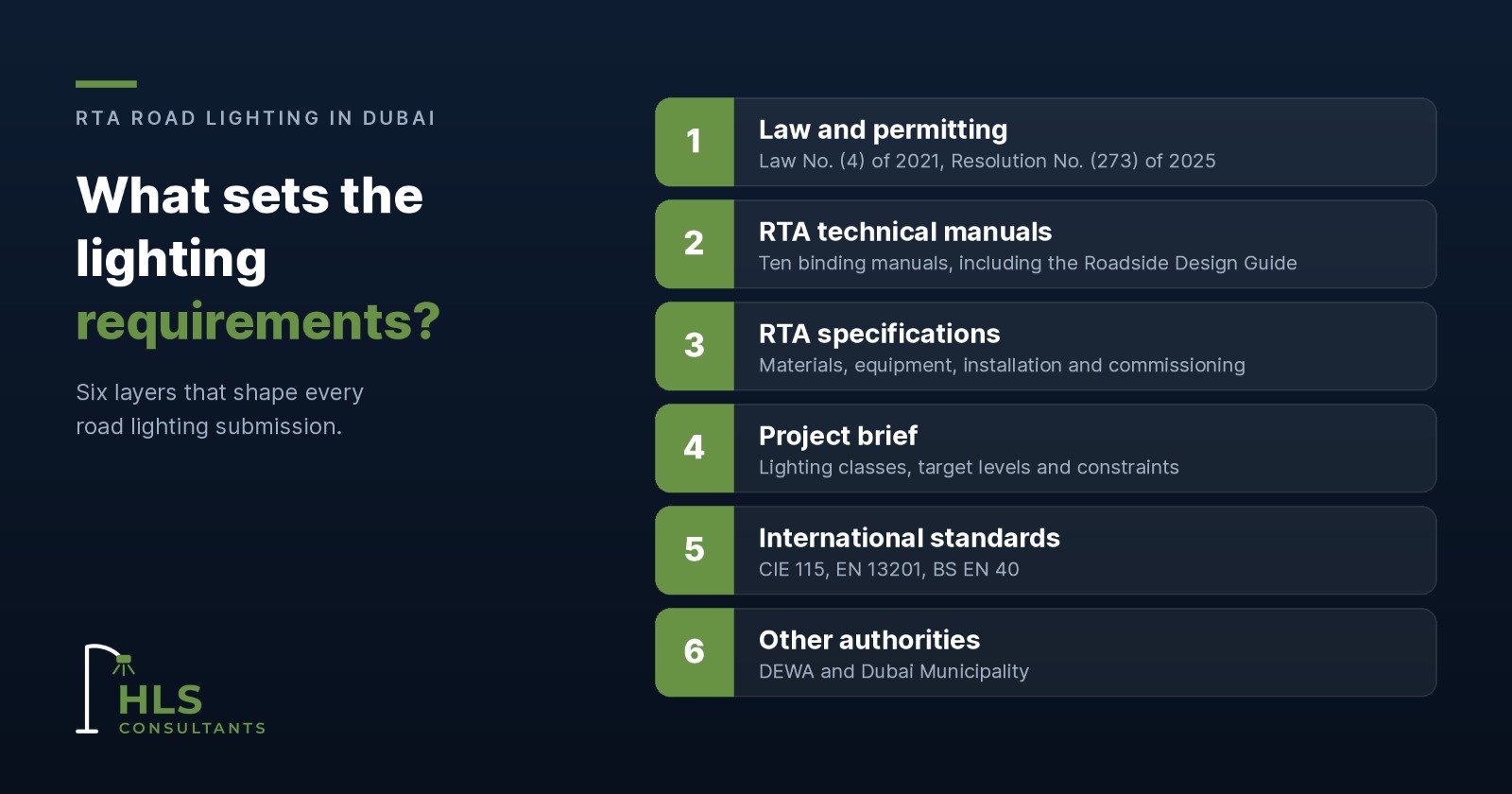
RTA road lighting requirements are not a single book with a neat cover. They are a stack: legislation that decides who may design and build in the road corridor, a list of binding technical manuals, project specifications that carry the actual lighting requirements, international standards used as the technical backbone, and approvals from other bodies on top. Once you see how the layers fit together, the whole picture becomes much clearer.
This guide walks through that stack for consultants working in road and street lighting design: what each layer controls, where the real lighting numbers come from, what the approval path looks like, and where submissions tend to go wrong.
A quick clarification first. RTA here means the Roads and Transport Authority of Dubai. If you landed here looking for the old Roads and Traffic Authority of New South Wales, that body no longer exists under that name, and its successors publish their own, completely separate standards.
In this guide:
- What people mean by “RTA road lighting standards”
- Who does what: RTA, Dubai Municipality and DEWA
- The permitting framework consultants need to know
- The ten approved technical manuals, and what each means for lighting
- So where are the actual lighting requirements?
- How the numbers are set: lighting classes and calculation basis
- Luminaires, columns, cables and cabinets: what to get right
- A realistic approval workflow
- What a strong lighting calculation package contains
- Common mistakes in RTA lighting submissions
- What is changing
- Frequently asked questions
- A pre-submission checklist
What people mean by “RTA road lighting standards”
When a project brief says “design to RTA standards”, it is pointing at several things at once:
| Layer |
What it controls |
Where it comes from |
| Law and permitting |
Who can design and build in the right of way, and what approvals they need |
Law No. (4) of 2021, Executive Council Resolution No. (54) of 2021, Administrative Resolution No. (273) of 2025 |
| Approved technical manuals |
Geometry, roadside safety, utilities, access, traffic control devices, work zones |
Ten RTA manuals listed in the 2025 resolution |
| RTA specifications |
Materials, workmanship, luminaires, columns, cables, cabinets, commissioning |
RTA project specifications, including the road lighting and electrical sections |
| Project requirements |
The actual lighting levels, classes and constraints for your scheme |
Employer Requirements, design brief, drawings |
| International standards |
Photometric method, classes, glare, column and luminaire standards |
CIE 115, the EN 13201 series, BS EN 40 and related documents |
| Other authorities |
Power supply, coordination, local roads |
DEWA, Dubai Municipality |
Who does what: RTA, Dubai Municipality and DEWA
The role of the RTA is set out in Law No. (4) of 2021 Regulating Roads. Under Article 5, the RTA plans, designs, constructs, manages and maintains roads and rights of way in the emirate. The law also requires free zone and special development zone authorities to obtain RTA approval for road and right-of-way designs and plans, and to use prequalified contractors and consultants.
For consultants, the key requirement is prequalification. Under Administrative Resolution No. (273) of 2025, a prequalification certificate is issued by the Traffic and Roads Agency (TRA) to a licensed contractor or consultant, authorising them to design, implement or supervise works within a right of way. Article 8 lists what is needed: a valid trade licence, CVs showing the qualifications and experience of staff, an approved organisational structure, a project portfolio with equipment and resources, contact details, and approvals from the relevant competent entities.
Two definitions in that resolution are worth reading closely, because they frame everything about lighting:
- Utility Lines explicitly include street lighting networks.
- RTA Assets explicitly include lamp posts, traffic lights, information signs and illuminated signboards.
In plain terms: a lighting cable route is treated like any other utility crossing the corridor, and a lighting column counts as an RTA asset. That is why the authority cares so much about where they go.
Around the RTA sit the other players. Depending on who owns the road and how it is powered, Dubai Municipality and the Dubai Electricity and Water Authority (DEWA) may also be involved. In practice, DEWA is the party you deal with for electrical supply approval, and Dubai Municipality remains involved where roads and lighting fall within its remit. Always confirm who owns the road you are working on, because that decides whose requirements lead.
The permitting framework consultants need to know
The 2025 resolution is the implementing bylaw of Executive Council Resolution No. (54) of 2021. It repealed Administrative Resolution No. (67) of 2010 on works in the right of way and Administrative Resolution No. (173) of 2007 on pavement occupancy, and Executive Council Resolution No. (54) of 2021 had already repealed Regulation No. (4) of 2009. If a template or checklist you inherited still cites the 2009 or 2010 texts, check it against the current legislation.
Here is what matters for lighting work.
No-objection certificates (NOCs). Excavation, permanent construction works and laying utility lines in a right of way or protection zone all need an NOC, applied for through the electronic system. Because lighting networks count as utility lines, new lighting cabling, ducts and foundations fall in this net. A few rules to note:
- When working near RTA road facilities, you must observe the critical and safe zone boundaries shown in the system.
- The TRA issues the NOC after coordinating with the competent entities and checking that your designs, drawings, safety requirements and method of execution comply.
- If you do not respond to comments, or complete requested documents, within 60 working days, the application is automatically cancelled (NOCs for building permits are an exception).
- An NOC is valid for a maximum of six months and can be renewed for the same period if you apply before it expires (NOCs for building permits are treated differently).
- The TRA can revoke or amend an NOC for things like deviation from approved plans, non-compliance with approved specifications, or abandoning the site.
Permits. Separate from NOCs, permits cover things like temporary traffic diversions, access points, pavement works and occupancy.
Clearance certificates. When the works are finished, the authorised person applies to the TRA within 30 days. The package includes the NOC, the snag list form, shop drawings per TRA standards, as-built drawings approved by the competent entities, and the other documents the resolution lists. Lighting as-builts belong in that package. Leave them out and you are holding up the clearance.
Traffic diversions. Diversion plans must follow the Work Zone Traffic Management Manual, which matters if your lighting works need lane closures.
The ten approved technical manuals, and what each means for lighting
Article 15 of the 2025 resolution approves ten RTA technical manuals and makes them binding on authorised persons, who must comply fully. Here is the list, with our practical reading of how each touches a lighting design. (The official text does not spell out lighting relevance, so treat the right-hand column as practical interpretation, not official wording.)
| Manual |
Why a lighting consultant should care |
| Right-of-Way Utilities Distribution Manual |
Decides where lighting ducts and cables can sit relative to water, power, telecoms and drainage. Plan the cable route on this, not on what is convenient. |
| Geometric Design Manual for Dubai Roads |
Cross-sections, medians, shoulders and verges set the physical space where columns can go. |
| Roadside Design Guide for Dubai |
Clear zones, slopes, barriers and hazard minimisation. Columns are fixed objects, so this drives offsets and protection. |
| Dubai Access Management Manual |
Access and junction spacing shape where conflict areas fall, which drives lighting levels. |
| Dubai Traffic Control Devices Manual |
Signs, signals and markings, including how lighting interacts with them. |
| Work Zone Traffic Management Manual |
Temporary arrangements during construction, including keeping lighting working in stages. |
| Dubai Traffic Safety Audit Manual |
Safety audits are where badly placed poles and dark crossings tend to get flagged. |
| Dubai Traffic Impact Studies Manual |
Indirect, but traffic forecasts feed road classification. |
| Dubai Trip Generation and Parking Rates Manual |
Indirect, relevant for parking and access areas. |
| Dubai Transport Integration Manual |
Relevant where roads meet stations, stops and pedestrian links. |
The Roadside Design Guide deserves extra attention. It deals with clear zones, slopes, barriers and other roadside hazards, and lighting columns are fixed objects. If you place a column on a high-speed road without checking it against this guide, expect a comment.
So where are the actual lighting requirements?
This is the practical answer to the question at the top of the article. The detailed lighting requirements sit in RTA specifications and project documents, not in a single approved design manual.
RTA specifications
RTA specifications for road projects typically include a road lighting section covering columns and brackets, luminaires and floodlights, low voltage cables, existing street lighting and high mast lighting, together with related items such as sign illumination and under-bridge lighting. A few points are useful to know:
- The required lighting level is normally set by the project drawings or the Engineer, not by a universal table, so the number comes from your project.
- Columns and brackets are commonly specified to the BS EN 40 series.
- Luminaires and floodlights are specified against the standards listed in the project specification.
- Luminance calculations need a stated road surface (a CIE R-class and its Q0 value), so check what the specification assumes.
A caution: specification editions vary from project to project. Before you rely on any clause, ask the RTA project team or the Engineer which edition applies to your project.
Electrical and installation requirements
Projects also carry specification requirements for the electrical side of road lighting, typically covering distribution cables between substations and light poles, cable installation, termination and testing, earthworks, luminaires, control cabinets and commissioning. This is what your contractor will build to, so your design drawings and the specification need to agree.
The project brief
The Employer Requirements or design brief usually name the lighting class or target values for each road category, plus special constraints such as decorative columns, colour temperature or control system requirements. Read them line by line. They override generic assumptions.
How the numbers are set: lighting classes and calculation basis
The technical backbone for most Dubai road lighting design is the CIE 115 and EN 13201 family of documents. These organise lighting into classes:
- M classes for motorised traffic roads, defined by average road surface luminance.
- C classes for conflict areas such as junctions, roundabouts and crossings, defined by average illuminance.
- P classes for pedestrians and cyclists, also by illuminance.
For reference, the EN 13201-2:2015 average luminance values for M classes are:
| Class |
Average luminance (cd/m²) |
Overall uniformity U₀ (min) |
| M1 |
2.0 |
0.40 |
| M2 |
1.5 |
0.40 |
| M3 |
1.0 |
0.40 |
| M4 |
0.75 |
0.40 |
| M5 |
0.5 |
0.35 |
| M6 |
0.3 |
0.35 |
And the C classes use average illuminance values of 50, 30, 20, 15, 10 and 7.5 lux for C0 to C5.
These tables also set longitudinal uniformity, threshold increment (the glare limit) and edge illuminance ratio requirements. The values above are taken from EN 13201-2:2015 for reference only. Use the full tables in the standard when you design, and confirm with the project brief which class applies where.
Why the road surface assumption matters
Luminance is what a driver sees, but it depends on how the road surface reflects light. The average luminance coefficient (Q0) captures that. Each CIE standard road surface has a typical Q0: R4, for example, has a Q0 of 0.08. A lower Q0 means the surface returns less light towards the driver.
Here is the practical effect, in simplified form. To get 1.0 cd/m² on a surface with a Q0 of 0.08, you need roughly 12.5 lux of average illuminance (1.0 ÷ 0.08). With a Q0 of 0.05, you would need about 20 lux for the same luminance. Real calculations use full reflection tables, not one number, but the principle holds: change the surface assumption and your layout changes. So state your surface assumption explicitly on every calculation sheet, and make sure it matches the specification.
Maintenance factor and the Dubai environment
Maintenance factor is where many otherwise good calculations get picked apart. It is the ratio of the maintained output of an installation to its initial output, and it combines lamp lumen maintenance, luminaire cleanliness and, where relevant, lamp survival. In a dusty, sandy environment, with coastal salt in places, you need to justify the dirt depreciation you have assumed and the cleaning interval it relies on. Whatever value you choose, write down the logic.
Keep each emirate separate
Abu Dhabi has its own road lighting guidance, separate from the RTA documents. If you work across emirates, keep the requirements separate, project by project.
Luminaires, columns, cables and cabinets: what to get right
This is where the RTA specifications do most of their work, and where your schedules and details need to line up with them.
Luminaires. The RTA has been moving to LED. In 2023 it upgraded 2,000 conventional lighting units on Airport Road and Al Ittihad Road to LED, a job it said took nearly six months, and described the new lamps as 4000K compared with 2000K for the old ones. In 2024 it announced a further 900 LED lighting units along 9 km of Sheikh Rashid Street. These are useful data points on the direction of travel, but your project specification still governs the colour temperature, optics, control gear and ingress protection you must use. Check ingress protection and corrosion resistance against the environment: sand, heat and salt spray are harder on equipment than many datasheets assume.
Columns and brackets. Where the specification refers to the BS EN 40 series, structural design, materials and corrosion protection should follow it. What you need to confirm for each project is whether passive safety performance is required for columns inside the clear zone, and how that fits with the Roadside Design Guide. Do not leave that to the shop drawings from the contractor.
Cables and ducts. The electrical specification deals with distribution cables from substations to poles, plus installation, termination and testing. Cable sizing, voltage drop and protection need to be demonstrated in your design package, and routes must respect the right-of-way utility allocation.
Control cabinets and commissioning. Expect requirements for the cabinet, switching or control arrangements and commissioning tests. Align your single-line diagrams and schedules to the spec so the contractor is not forced to interpret.
Special elements. Road lighting specifications commonly cover high mast lighting with raising and lowering gear, sign illumination and under-bridge lighting. Tunnels are a different discipline altogether and follow their own tunnel lighting guidance (CIE 88 is the usual reference), not the open-road classes.
A realistic approval workflow
The exact path depends on the project type, but a clean run for a lighting design inside a road project generally looks like this:
- Confirm prequalification. The appointed consultant, and where needed the contractor, must hold current RTA prequalification for works in the right of way.
- Get the brief and the right spec edition in writing. Class by road category, colour temperature, control approach, any decorative requirements.
- Establish the corridor. Overlay the standard cross-section and utilities allocation, then locate columns, ducts and pillars within it.
- Check roadside safety. Test pole positions against clear zone and offset requirements in the Roadside Design Guide.
- Run the photometric design. Use certified photometric files, state the road surface, maintenance factor and class, and report all required criteria, including glare.
- Develop the electrical design. Load, cable sizing, voltage drop, protection, earthing, and supply arrangements with DEWA.
- Submit through the system. Apply for the NOC with complete drawings and calculations, and coordinate with the other competent entities.
- Respond to comments fast. The 60-working-day clock to respond to comments is a hard stop, not a guideline.
- Plan the works around traffic management. Staging should keep existing lighting functioning where possible, within the Work Zone Traffic Management Manual.
- Close out properly. Snag list, shop drawings, approved as-builts and the clearance certificate within 30 days of completion.
What a strong lighting calculation package contains
The quickest way to get a design approved is to remove every reason for a reviewer to ask a question. A good package includes:
- The design basis: road classification, lighting class and where it came from in the brief
- Road geometry, lane widths, median and verge widths, and the surface assumption (R-class and Q0)
- Luminaire photometric files with the reference of the manufacturer test report
- Maintenance factor breakdown and the cleaning interval it assumes
- Layout drawings showing pole positions, offsets, spacing, arm lengths and mounting heights
- Results grids and summary tables for luminance or illuminance, uniformity and glare, per class and per area
- Conflict area definitions at junctions, roundabouts and crossings, with the class applied to each
- Cable routes against the utilities allocation, with sizes, voltage drop and protection
- Details for foundations, columns and cabinets that match the specification
- A temporary lighting note if staging affects existing lighting
Common mistakes in RTA lighting submissions
These are common patterns, and most come straight from how the framework is structured.
- Treating a European or British standard as the RTA standard. The standards are the backbone, but the spec and the project brief decide what is required.
- Working from an outdated specification edition. Always confirm the current one.
- Leaving lighting out of the right-of-way allocation. Cables are utility lines, so they need a place in the corridor.
- Ignoring the Roadside Design Guide. A neat calculation does not help if the columns sit where a vehicle will hit them.
- Unstated assumptions. If the surface, maintenance factor or class is not written on the sheet, the reviewer has to guess, and that rarely goes your way.
- Over-lighting to be safe. Excess light levels waste energy, add cost and can attract review comments. Design to the class the brief requires.
- Forgetting staging. A lighting outage during diversions is a safety problem and a quick way to attract complaints.
- Slow responses. Missing the 60-working-day window cancels your application.
- Incomplete close-out. Missing as-builts or snags delay the clearance certificate, and everything after it.
What is changing
Three things are worth watching.
The legal framework was refreshed in 2025. Administrative Resolution No. (273) of 2025 replaced the previous implementing bylaws, formalised the list of binding manuals and set out the procedures for NOCs, permits, prequalification and clearance.
LED and smarter control keep spreading. The LED conversion work by the RTA on major roads shows where the network is heading. Expect briefs to ask for dimming, remote monitoring and better energy performance.
The EN 13201 series is being revised. A BSI draft of Part 2 was published for public comment in May 2026, and CEN drafts of Parts 2 and 3 carry a 2026 designation (prEN 13201-2:2026 and prEN 13201-3:2026). Until the revised parts are published, the 2015 editions remain the reference, so ask which edition your project uses, particularly if it runs for several years.
Frequently asked questions
Does the RTA have a road lighting design manual?
Not among the ten technical manuals approved and made binding in the 2025 resolution. Lighting requirements are carried in RTA specifications and project documents, with international standards providing the method. Confirm the current documents with the RTA project team.
Who approves street lighting design in Dubai?
For roads under the RTA, lighting design and works in the right of way go through the RTA process, with NOCs applied for through the TRA electronic system. DEWA is involved in the electrical supply, and Dubai Municipality may be involved where a road falls within its remit. Always confirm who owns the road before you start.
Does the RTA follow CIE 115 or EN 13201?
Road lighting design for RTA projects commonly uses CIE methods for calculations, and EN 13201 is the most common framework for classes and criteria. Which documents and editions apply is set by the project specification, so confirm it at the start.
Do consultants need RTA prequalification?
Yes, for design, implementation or supervision of works within a right of way. The requirements include a trade licence, staff CVs, an organisational structure, a project portfolio and approvals from the competent entities.
How long is an NOC valid?
A maximum of six months, renewable for the same period if you apply before it expires. NOCs for building permits are treated differently.
What happens if I do not answer RTA comments?
Except for building-permit NOCs, the application is cancelled automatically if you do not respond within 60 working days of receiving the comments or being asked to complete documents.
Which colour temperature does the RTA use for road lighting?
Its 2023 retrofit on Airport Road and Al Ittihad Road used 4000K LEDs, but the project specification governs. Do not assume it carries over to every scheme.
Can I apply Abu Dhabi lighting criteria to a Dubai project?
No. Abu Dhabi has its own road lighting guidance. Use the RTA documents and your project brief for Dubai.
Do lighting columns have to be breakaway?
It depends on the location and the project requirements. The Roadside Design Guide governs hazards in the clear zone, and column specifications commonly refer to the BS EN 40 series, so confirm early whether passive safety performance is needed for columns inside the clear zone.
A pre-submission checklist
Before you press submit, run through these:
- Does the appointed consultant hold current prequalification, and does it cover this work?
- Do I have the current RTA specification edition and the project brief in writing?
- Is the lighting class for every road and conflict area traceable to the brief?
- Do the calculations state the surface, maintenance factor and luminaire data source?
- Are all columns checked against clear zone and offset requirements?
- Are cable routes inside the utilities allocation?
- Is the electrical supply agreed with DEWA?
- Does staging keep lighting working during diversions?
- Do my schedules match the RTA specification clause by clause?
- Have I diarised the 60-working-day comment deadline and the 30-day clearance application?
Get those ten right and most of the friction in RTA lighting approvals disappears. The standards are not hidden. They are just spread across more documents than anyone would like, and the consultants who map them early are the ones whose drawings move through quickly.
At HLS Consultants, we support consultants and contractors on road lighting and electrical design as an extension of their team, including calculation packages and drawings prepared for review. If you need extra capacity on a Dubai road lighting scheme, get in touch.
About this guide
This guide is general information based on publicly available legislation and standards as of November 2026. It is not legal advice. Requirements change, so always confirm current requirements with the RTA and the relevant authorities before relying on them. HLS Consultants is an independent consultancy and is not affiliated with, or endorsed by, the Roads and Transport Authority.
Sources and further reading
- Law No. (4) of 2021 Regulating Roads in the Emirate of Dubai (Dubai Legislation Portal)
- Executive Council Resolution No. (54) of 2021 Regulating Works in the Right of Way (Dubai Legislation Portal)
- Administrative Resolution No. (273) of 2025 Issuing the Implementing Bylaw of Executive Council Resolution No. (54) of 2021 Regulating Works in the Right of Way (Dubai Legislation Portal)
- RTA Roadside Design Guide for Dubai and the RTA technical manuals published on the RTA website
- RTA LED upgrade of Airport Road and Al Ittihad Road (Gulf News, September 2023)
- RTA LED upgrade of Sheikh Rashid Street (Dubai Media Office, May 2024)
- CIE 115:2010 and the EN 13201 series (2015 editions); draft revisions prEN 13201-2:2026 and prEN 13201-3:2026; BSI public comment draft of BS EN 13201-2 (May 2026)


If you have been asked to design road and street lighting to RTA standards in Dubai, one of the first questions is where those standards actually sit. The answer is not a single manual, and that is where much of the confusion starts.
RTA road lighting requirements are not a single book with a neat cover. They are a stack: legislation that decides who may design and build in the road corridor, a list of binding technical manuals, project specifications that carry the actual lighting requirements, international standards used as the technical backbone, and approvals from other bodies on top. Once you see how the layers fit together, the whole picture becomes much clearer.
This guide walks through that stack for consultants working in road and street lighting design: what each layer controls, where the real lighting numbers come from, what the approval path looks like, and where submissions tend to go wrong.
A quick clarification first. RTA here means the Roads and Transport Authority of Dubai. If you landed here looking for the old Roads and Traffic Authority of New South Wales, that body no longer exists under that name, and its successors publish their own, completely separate standards.
In this guide:
What people mean by “RTA road lighting standards”
When a project brief says “design to RTA standards”, it is pointing at several things at once:
Who does what: RTA, Dubai Municipality and DEWA
The role of the RTA is set out in Law No. (4) of 2021 Regulating Roads. Under Article 5, the RTA plans, designs, constructs, manages and maintains roads and rights of way in the emirate. The law also requires free zone and special development zone authorities to obtain RTA approval for road and right-of-way designs and plans, and to use prequalified contractors and consultants.
For consultants, the key requirement is prequalification. Under Administrative Resolution No. (273) of 2025, a prequalification certificate is issued by the Traffic and Roads Agency (TRA) to a licensed contractor or consultant, authorising them to design, implement or supervise works within a right of way. Article 8 lists what is needed: a valid trade licence, CVs showing the qualifications and experience of staff, an approved organisational structure, a project portfolio with equipment and resources, contact details, and approvals from the relevant competent entities.
Two definitions in that resolution are worth reading closely, because they frame everything about lighting:
In plain terms: a lighting cable route is treated like any other utility crossing the corridor, and a lighting column counts as an RTA asset. That is why the authority cares so much about where they go.
Around the RTA sit the other players. Depending on who owns the road and how it is powered, Dubai Municipality and the Dubai Electricity and Water Authority (DEWA) may also be involved. In practice, DEWA is the party you deal with for electrical supply approval, and Dubai Municipality remains involved where roads and lighting fall within its remit. Always confirm who owns the road you are working on, because that decides whose requirements lead.
The permitting framework consultants need to know
The 2025 resolution is the implementing bylaw of Executive Council Resolution No. (54) of 2021. It repealed Administrative Resolution No. (67) of 2010 on works in the right of way and Administrative Resolution No. (173) of 2007 on pavement occupancy, and Executive Council Resolution No. (54) of 2021 had already repealed Regulation No. (4) of 2009. If a template or checklist you inherited still cites the 2009 or 2010 texts, check it against the current legislation.
Here is what matters for lighting work.
No-objection certificates (NOCs). Excavation, permanent construction works and laying utility lines in a right of way or protection zone all need an NOC, applied for through the electronic system. Because lighting networks count as utility lines, new lighting cabling, ducts and foundations fall in this net. A few rules to note:
Permits. Separate from NOCs, permits cover things like temporary traffic diversions, access points, pavement works and occupancy.
Clearance certificates. When the works are finished, the authorised person applies to the TRA within 30 days. The package includes the NOC, the snag list form, shop drawings per TRA standards, as-built drawings approved by the competent entities, and the other documents the resolution lists. Lighting as-builts belong in that package. Leave them out and you are holding up the clearance.
Traffic diversions. Diversion plans must follow the Work Zone Traffic Management Manual, which matters if your lighting works need lane closures.
The ten approved technical manuals, and what each means for lighting
Article 15 of the 2025 resolution approves ten RTA technical manuals and makes them binding on authorised persons, who must comply fully. Here is the list, with our practical reading of how each touches a lighting design. (The official text does not spell out lighting relevance, so treat the right-hand column as practical interpretation, not official wording.)
The Roadside Design Guide deserves extra attention. It deals with clear zones, slopes, barriers and other roadside hazards, and lighting columns are fixed objects. If you place a column on a high-speed road without checking it against this guide, expect a comment.
So where are the actual lighting requirements?
This is the practical answer to the question at the top of the article. The detailed lighting requirements sit in RTA specifications and project documents, not in a single approved design manual.
RTA specifications
RTA specifications for road projects typically include a road lighting section covering columns and brackets, luminaires and floodlights, low voltage cables, existing street lighting and high mast lighting, together with related items such as sign illumination and under-bridge lighting. A few points are useful to know:
A caution: specification editions vary from project to project. Before you rely on any clause, ask the RTA project team or the Engineer which edition applies to your project.
Electrical and installation requirements
Projects also carry specification requirements for the electrical side of road lighting, typically covering distribution cables between substations and light poles, cable installation, termination and testing, earthworks, luminaires, control cabinets and commissioning. This is what your contractor will build to, so your design drawings and the specification need to agree.
The project brief
The Employer Requirements or design brief usually name the lighting class or target values for each road category, plus special constraints such as decorative columns, colour temperature or control system requirements. Read them line by line. They override generic assumptions.
How the numbers are set: lighting classes and calculation basis
The technical backbone for most Dubai road lighting design is the CIE 115 and EN 13201 family of documents. These organise lighting into classes:
For reference, the EN 13201-2:2015 average luminance values for M classes are:
And the C classes use average illuminance values of 50, 30, 20, 15, 10 and 7.5 lux for C0 to C5.
These tables also set longitudinal uniformity, threshold increment (the glare limit) and edge illuminance ratio requirements. The values above are taken from EN 13201-2:2015 for reference only. Use the full tables in the standard when you design, and confirm with the project brief which class applies where.
Why the road surface assumption matters
Luminance is what a driver sees, but it depends on how the road surface reflects light. The average luminance coefficient (Q0) captures that. Each CIE standard road surface has a typical Q0: R4, for example, has a Q0 of 0.08. A lower Q0 means the surface returns less light towards the driver.
Here is the practical effect, in simplified form. To get 1.0 cd/m² on a surface with a Q0 of 0.08, you need roughly 12.5 lux of average illuminance (1.0 ÷ 0.08). With a Q0 of 0.05, you would need about 20 lux for the same luminance. Real calculations use full reflection tables, not one number, but the principle holds: change the surface assumption and your layout changes. So state your surface assumption explicitly on every calculation sheet, and make sure it matches the specification.
Maintenance factor and the Dubai environment
Maintenance factor is where many otherwise good calculations get picked apart. It is the ratio of the maintained output of an installation to its initial output, and it combines lamp lumen maintenance, luminaire cleanliness and, where relevant, lamp survival. In a dusty, sandy environment, with coastal salt in places, you need to justify the dirt depreciation you have assumed and the cleaning interval it relies on. Whatever value you choose, write down the logic.
Keep each emirate separate
Abu Dhabi has its own road lighting guidance, separate from the RTA documents. If you work across emirates, keep the requirements separate, project by project.
Luminaires, columns, cables and cabinets: what to get right
This is where the RTA specifications do most of their work, and where your schedules and details need to line up with them.
Luminaires. The RTA has been moving to LED. In 2023 it upgraded 2,000 conventional lighting units on Airport Road and Al Ittihad Road to LED, a job it said took nearly six months, and described the new lamps as 4000K compared with 2000K for the old ones. In 2024 it announced a further 900 LED lighting units along 9 km of Sheikh Rashid Street. These are useful data points on the direction of travel, but your project specification still governs the colour temperature, optics, control gear and ingress protection you must use. Check ingress protection and corrosion resistance against the environment: sand, heat and salt spray are harder on equipment than many datasheets assume.
Columns and brackets. Where the specification refers to the BS EN 40 series, structural design, materials and corrosion protection should follow it. What you need to confirm for each project is whether passive safety performance is required for columns inside the clear zone, and how that fits with the Roadside Design Guide. Do not leave that to the shop drawings from the contractor.
Cables and ducts. The electrical specification deals with distribution cables from substations to poles, plus installation, termination and testing. Cable sizing, voltage drop and protection need to be demonstrated in your design package, and routes must respect the right-of-way utility allocation.
Control cabinets and commissioning. Expect requirements for the cabinet, switching or control arrangements and commissioning tests. Align your single-line diagrams and schedules to the spec so the contractor is not forced to interpret.
Special elements. Road lighting specifications commonly cover high mast lighting with raising and lowering gear, sign illumination and under-bridge lighting. Tunnels are a different discipline altogether and follow their own tunnel lighting guidance (CIE 88 is the usual reference), not the open-road classes.
A realistic approval workflow
The exact path depends on the project type, but a clean run for a lighting design inside a road project generally looks like this:
What a strong lighting calculation package contains
The quickest way to get a design approved is to remove every reason for a reviewer to ask a question. A good package includes:
Common mistakes in RTA lighting submissions
These are common patterns, and most come straight from how the framework is structured.
What is changing
Three things are worth watching.
The legal framework was refreshed in 2025. Administrative Resolution No. (273) of 2025 replaced the previous implementing bylaws, formalised the list of binding manuals and set out the procedures for NOCs, permits, prequalification and clearance.
LED and smarter control keep spreading. The LED conversion work by the RTA on major roads shows where the network is heading. Expect briefs to ask for dimming, remote monitoring and better energy performance.
The EN 13201 series is being revised. A BSI draft of Part 2 was published for public comment in May 2026, and CEN drafts of Parts 2 and 3 carry a 2026 designation (prEN 13201-2:2026 and prEN 13201-3:2026). Until the revised parts are published, the 2015 editions remain the reference, so ask which edition your project uses, particularly if it runs for several years.
Frequently asked questions
Does the RTA have a road lighting design manual?
Not among the ten technical manuals approved and made binding in the 2025 resolution. Lighting requirements are carried in RTA specifications and project documents, with international standards providing the method. Confirm the current documents with the RTA project team.
Who approves street lighting design in Dubai?
For roads under the RTA, lighting design and works in the right of way go through the RTA process, with NOCs applied for through the TRA electronic system. DEWA is involved in the electrical supply, and Dubai Municipality may be involved where a road falls within its remit. Always confirm who owns the road before you start.
Does the RTA follow CIE 115 or EN 13201?
Road lighting design for RTA projects commonly uses CIE methods for calculations, and EN 13201 is the most common framework for classes and criteria. Which documents and editions apply is set by the project specification, so confirm it at the start.
Do consultants need RTA prequalification?
Yes, for design, implementation or supervision of works within a right of way. The requirements include a trade licence, staff CVs, an organisational structure, a project portfolio and approvals from the competent entities.
How long is an NOC valid?
A maximum of six months, renewable for the same period if you apply before it expires. NOCs for building permits are treated differently.
What happens if I do not answer RTA comments?
Except for building-permit NOCs, the application is cancelled automatically if you do not respond within 60 working days of receiving the comments or being asked to complete documents.
Which colour temperature does the RTA use for road lighting?
Its 2023 retrofit on Airport Road and Al Ittihad Road used 4000K LEDs, but the project specification governs. Do not assume it carries over to every scheme.
Can I apply Abu Dhabi lighting criteria to a Dubai project?
No. Abu Dhabi has its own road lighting guidance. Use the RTA documents and your project brief for Dubai.
Do lighting columns have to be breakaway?
It depends on the location and the project requirements. The Roadside Design Guide governs hazards in the clear zone, and column specifications commonly refer to the BS EN 40 series, so confirm early whether passive safety performance is needed for columns inside the clear zone.
A pre-submission checklist
Before you press submit, run through these:
Get those ten right and most of the friction in RTA lighting approvals disappears. The standards are not hidden. They are just spread across more documents than anyone would like, and the consultants who map them early are the ones whose drawings move through quickly.
At HLS Consultants, we support consultants and contractors on road lighting and electrical design as an extension of their team, including calculation packages and drawings prepared for review. If you need extra capacity on a Dubai road lighting scheme, get in touch.
About this guide
This guide is general information based on publicly available legislation and standards as of November 2026. It is not legal advice. Requirements change, so always confirm current requirements with the RTA and the relevant authorities before relying on them. HLS Consultants is an independent consultancy and is not affiliated with, or endorsed by, the Roads and Transport Authority.
Sources and further reading